 The Market Monitor Minding the Nation's Business
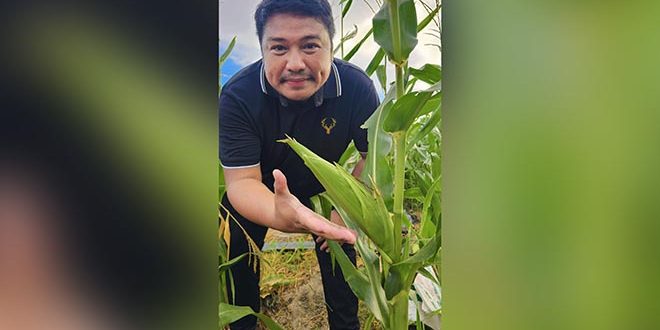

Call him blessed but James Penaflorida Amparo journey into a full-blown agri enterprises has had a lot of pitfalls and risks that no businessman in his right mind would trod. But he did.
James began his company– the Yovel East AgriVentures– in 2014 as a research and development firm that tried different farming technologies to improve the farmers’ access to technology, increase their yields and productivity and, along the way, their incomes. But he registered the family corporation in 2010 and spent three years specifically as R & D.
He developed products, technology and farm machinery to ease the load of farmers, for example a ladder that coconut climbing machine that workers can use to harvest the ripe nuts from tall trees, Fuzon generators for water pumps that he sold abroad and soil nutrients that are patented to his company.
The main office is in Quezon City but his farmer cooperators are from Tarlac where they plant rice and corn; Sariaya in Quezon province where they planted rice, corn, vegetables and other high value crops and Davao for bananas and durian.
He was able to cluster around 5,000 farmers– some tilling 1, 2, 3 and 4 hectares. In Tarlac for instance, he clustered mostly rice and corn farmers, in Quezon clustering was very flexible because of rice, corn, high value crops and livestocks and in Davao around 50 hectares of mostly fruits like lakatan bananas which the company passes on to viajeros and retailers every week.
“We are now among the biggest producers and exporters of durian to China this year. We are now managing almost 3,000 trees of durian in Davao,” he said.
All his 3,000 trees are fruit bearing with ages 10 years and up with each tree yielding 200 to 300 durian fruit of at least 3 kilos each. The fresh durian reaches China in five to seven days. There is no such thing as peak or lean season for durian in China. None of his durian harvest in October or November is sold in the Philippines.
The biggest supplier of durian in China is Indonesia, Vietnam and Thailand, which harvest durian in June and July.
He is actively involved in the “big brother-small brother” program of KALAP (or the Kapatid Angat Lahat for Agriculture Program of Presidential Assistant Joey Concepcion for entrepreneurship). His company provides seeds and fertilizers to 5,000 farmers as well as subsistence buy back program, but he does not oblige them to sell their produce exclusively to his company.
“We in fact encourage them to sell where the price is high and just pay us for the loans they get from us,” he shared.
In Tarlac, a dry area, he asked the farmers not to plant rice in the main dry season crop because of the El Nino even if their farms are being reached by the irrigation systems (through pumps) of the government. He instead advised them to plant yellow corn for animal feeds (which does not require much water). He said he has institutional buyers for rice and corn.
“But if they still want to plant rice, I can’t do anything about it,” he said.
The vegetables that his farmer-cooperators plant all go to the Bureau of Corrections since “we have a long-term contract with them for the food needs of detainees. Some, however go to bagsakan centers like Balintawak.
The problem with Philippine agriculture is that we are dealing with individual farmers. We can not distinguish who are the buyers, the growers or the exporters, processors. For example in durian, the big Chinese buyers do not know who to talk to in the Philippines.
He admits that he does not come from a wealthy family. His dad was a janitor but finished high school and later became a trusted employee of the Gotianuns of Filinvest while his mom was a secretary of the big boss Gotianun. His grandpa owned farm lands which eventually got divided to 7 siblings. But this is where he and his father learned agriculture although James graduated Film Development at the University of the Philippines.
He said his early exposure to farming and farmers– why and how they remain poor– has made him develop a business model, which despite the huge risks, is meant to help uplift farmers and in the process, his business as well.
“But God has always repaid me in blessings and the problem-solving talent in ways I could never imagine,” he shared.
While in college he had done a lot of documentaries about the plight of the Filipino farmers and he looked at possible solutions to their problems. “Luckily I have lots of friends at the Department of Agriculture, local and national government offices, entrepreneurs and I am fortunate to be able to network with other agriculture experts from other countries,” he said.
His fertilizer company produces 60 to 70 percent organic and the rest is chemical fertilizer, and all of its products are registered and licensed by the Fertilizer and Pesticides Authority.
He said the most critical problem in agriculture is not the lack of technology but management of the farmers and farms.