 The Market Monitor Minding the Nation's Business
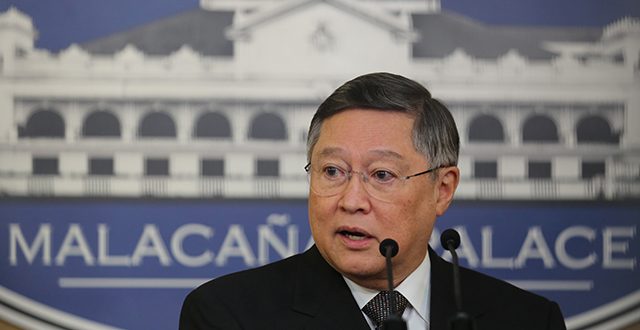
The first package of the comprehensive tax-reform program (CTRP) now pending in Congress will serve as the “cornerstone” of the funding for the government’s ambitious infrastructure program of the government which will require P6 trillion over the medium term.
“Essentially, [the infra buildup] will be financed really in three ways. The first is it will be financed by our taxes, that’s why we have to put up our tax reform program, that’s why we have to get it passed. That is the cornerstone of the financing of this program. Secondly, we will utilize ODA (official development assistance) funds. And third, of course we will utilize commercial loans,” said Finance Secretary Carlos Dominguez III.
“Dutertenomics,” is President Duterte’s economic strategy to dramatically raise funds–in large part through his proposed tax reform program–and spend big on infrastructure, human capital formation and social protection to sustain the growth momentum, attract investments and create jobs, achieve economic inclusion and transform the Philippines into a high middle-income country by 2022, by which time poverty incidence will have been reduced to 14 percent.
Dominguez said the Philippines, under a fast-integrating regional economy, is well positioned to address the needs of the other member-states of the Association of Southeast Asian Nations (Asean), but should catch up with its neighbors fast in terms of addressing the country’s weak infrastructure backbone to capitalize on this massive opportunity that will create hundreds of thousands of jobs for Filipinos.
“We are positioned very well in Asean to address the needs of Asia. However, we cannot achieve our full potential because we cannot even move our goods properly within our own country. So it’s very important for us to focus on the infrastructure that delivers good logistics in the Philippines,” he said.
Dominguez likewise underscored the need of having the CTRP passed by the Congress soon to enable the government to jumpstart its ambitious infra program.
He said that if the CTRP fails to hurdle the Congress, “we’ll cut the infrastructure projects, obviously.”
The first package of the CTRP, which aims to lower personal income tax rates, alongside reforming the excise tax system for fuel and automobiles, and expanding the VAT base while retaining exemptions for seniors and persons with disabilities, among other measures, has yet to be approved at the committee level in the House of Representatives.
Before the Lenten break of the Congress, the House Ways and Means Committee chaired by Dakila Carlo Chua already agreed in principle to tackle the bill as a package, which puts to rest concerns that the Congress might abandon the revenue-generating measures of the proposal and only pass the revenue-eroding portion lowering income tax rates.
Dominguez said that Malacañang’s plan to accelerate spending on infrastructure and on human capital by upgrading the country’s educational and health care systems, along with its goal to lower income tax rates to sharpen the Philippines’ global competitiveness, would require additional revenue measures that could only be generated via the CTRP.
If “Dutertenomics” is sustained over the medium term, the government envisions the Philippines to be a high-income economy in one generation or by 2040.
The Dutertenomics forum, the first in a series to be held by Malacanang, presented to the public the government’s “Build, Build, Build” program consisting of big-ticket infra projects, among them the NLEx-SLEx Connector Road, the Bonifacio-Ortigas Road Link, Mindanao Railway, New Clark City, and the Mega Manila Subway.
Now is the time to move decisively in carrying out this “grand effort,” Dominguez said, given the convergence of positive factors that are conducive to high and inclusive growth, such as the economy’s low-interest rate regime, excess liquidity, benign oil prices, investment-grade credit rating, a young, vigorous work force and the strong support of countries like Japan and China.
Japan and China are among the economies that have pledged to support the government’s unprecedented public investment program following President Duterte’s visits to these countries last year. The combined commitments of China and Japan, in terms of ODA alone amount to over P1 trillion.