 The Market Monitor Minding the Nation's Business
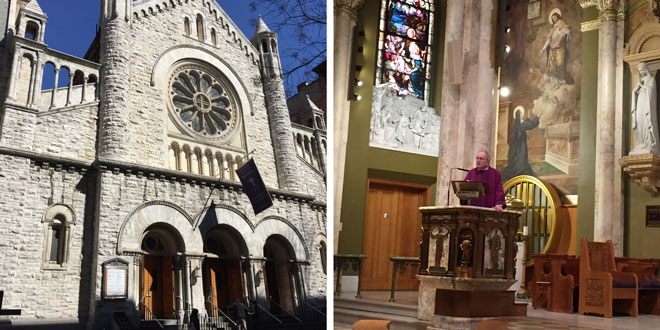
 As in most about anything one finds in the “city of the world” (New York), churches unfailingly enthrall a visitor no end. But once the wonder over gorgeous details from the transept to the main altar wanes, one realizes that what deeply draws the beholder, a Filipino like me, for instance, apparently turns out to be the bits of glory one faintly recognizes—what Philippine province does not pride itself with a heritage church?
Where I grew up in Ilocos, for instance, baroque churches like San Andres Apostol (Saint Andrew, the Apostle) with its fractured tower—the country’s tallest once, humbled since by succeeding earthquakes—to this day, wraps me in memories of glorious rituals under candle-lit haze in its cathedral-like dimension. Or when I think of Vigan, it’s always the square defined by the seminary, a heavenly wonderland, when as I girl, I tugged along my grandmother and a grandaunt on the Feast of the Immaculate Conception, patroness of the seminary, where two uncles studied to be priests (only one sustained his vocation), sadly razed and replaced since by fast food chains.
Like Regulus in the summer sky or Stella Maris, the evening star on a shore, indeed, a spire or tower unfailingly beckons Catholics. A priest though, also once described a church where one feels closest to the divine as one’s “well of grace”; indeed, it’s an image that vivifies how we dip into fathomless sources for enlightenment, or simply to draw out for a sip, “water to refresh or quench an overwrought spirit,” in the course of discovering a place or, yes, a well, for one’s own dryness. One can stretch the imagery beyond just one church in New York, where no experience has been the same, for most, more so, an epiphany, for me, in a few of the 26 or so among 96 of Manhattan’s I’ve heard Mass or adored the Blessed Sacrament.
Younger by 200 hundred years or more than those of the Philippines’s, New York churches, with stunning haloed lights from stained-glass windows, a hush encasing walls from the dome, shadowed corners, some hidden by latticed dividers, to glinting silver candelabras and crystal chandeliers, which with the reflective mist these creates, do transport a visitor or the devout to mystical realms.
Comparisons, of course, prove farfetched. For example, none of the massive stone and mortar baroque churches of the Philippines sculpt New York landscapes. Instead, gothic revivals exquisitely rise on morning clouds. Some wonders though, that don’t seem to end could entrance you at the Byzantine Holy Trinity Church on 82nd St., as well as hybrid details of Sicilian Romanesque and Byzantine of Ascension Church on West 107th St. At St. Patrick’s Cathedral on Fifth Avenue, of course, even in later visits, you could still make an effort to cease gazing at the altar, and soon, sinking deep into prayer.
Quite apparent, would be the varied cultures same as what define neighborhoods, which each church narrates through its patron saint and traditions. In Little Italy at the Lower Eastside, for example, where alongside the Chinese, Italians had settled, the Church of the Precious Blood and Shrine of San Gennaro, would introduce you to this patron saint of Naples, whose blood liquefies to this day, and whom the Italians honor with a weeklong street festival.
I once heard Sunday Mass with a friend at the Most Holy Crucifix tucked on Broome St. also in Chinatown, when it was yet another Italian church, converted since by the archdiocese of New York to the Shrine of San Lorenzo Ruiz de Manila, where Filipinos hold weekly devotions. We’ve been regaled with Mexican Mariachi music in a celebration of the Guadalupe Lady’s feast at Ascension Church, and once, caught the last Sunday Mass in Creole at Holy Name Church on 96th Street.
Quite unaware of it, my churchgoing began to turn into a pilgrimage. I realized recently that I’ve been kneeling on pews, where pillars of spirituality once did, like the poet and mystic monk, Thomas Merton, baptized Catholic at Corpus Christi Parish in the Upper West Side. St. Peter’s, the oldest Catholic church in the US, a recent landmark being right across from where the World Trade Center once stood, turns out to be where Elizabeth Seton, America’s first saint, was also baptized Catholic.
At St. Agnes Church midtown, frequented by employees at the nearby United Nations offices, I had listened to enlightening 5-minute homilies, delivered, I later learned, in the tradition of Fulton J. Sheen, whose 50-year radio and television broadcasts for the Society of the Propagation of the Faith this church hosted, and of which printed versions I had avidly read.
None of what I’ve experienced here might make sense to others, considering what else Manhattan offers. But it has taken me time to recognize how deeply our faith finds sustenance at every turn our lives take more than the effort we take to find if we let it, that is. As well, spirituality, I believe, is a grace bestowed in as uniquely a manner as to whom we are.