 The Market Monitor Minding the Nation's Business
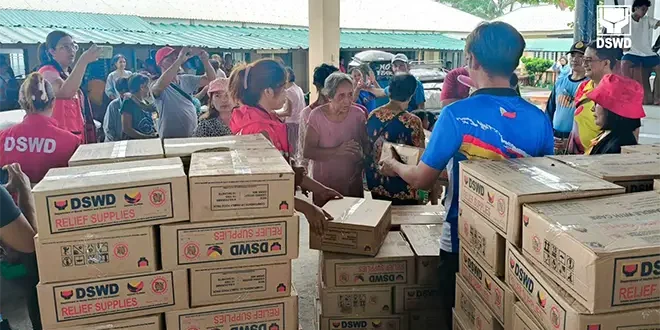
The Department of Social Welfare and Development (DSWD) on Thursday underscored the success of its Buong Bansa Handa (BBH) project, which enabled the agency to swiftly meet the immediate needs of families affected by Severe Tropical Storm Kristine (Trami).
As of 6 a.m. on Thursday, the DSWD had distributed 71,514 family food packs (FFPs) and 2,134 non-food items (NFIs) worth P55.28 million to storm-affected communities nationwide.
Leo Quintilla, Special Assistant to the Secretary for the Disaster Response and Management Group (DRMG) and Officer-in-Charge of the National Resource and Logistics Management Bureau (NRLMB), explained that this rapid response was made possible through the BBH initiative, which operates two parallel supply chains for disaster preparedness and response.
“The first supply chain is driven by the national and local governments, while the second involves partnerships with large and small groceries, supermarkets, manufacturers, and distributors, leveraging their expertise and resources to create a private sector-driven supply chain,” Quintilla said during a media forum at the DSWD Central Office in Quezon City.
He added that in just one day, the DSWD released 17,000 FFPs, marking the fastest deployment to date. He credited this efficiency to the BBH project, which focuses on pre-positioning FFPs across strategic locations: hubs, spokes, and last-mile facilities.
Hubs are production and storage centers, including three National Resource Operations Centers (NROCs) in Metro Manila (Pasay, Valenzuela, and Parañaque), the Visayas Disaster Resource Center (VDRC) in Cebu, and hubs in Central Luzon and Davao Region. A new hub is also under construction in Butuan City to serve Mindanao. Each hub can produce 10,000 to 15,000 FFPs per day.
In addition, the DSWD has 75 spokes facilities nationwide, provided by local government units (LGUs) in key cities and municipalities. These regional warehouses, managed or rented by the DSWD, can store 5,000 to 10,000 FFPs.
Lastly, last-mile warehouses are strategically located in hard-to-reach areas, including Geographically Isolated and Disadvantaged Areas (GIDA), typically 4th to 6th class municipalities. These smaller facilities have a storage capacity of less than 5,000 FFPs.
Through this comprehensive network, the DSWD pre-positioned more than 2 million FFPs across its facilities nationwide, well before Storm Kristine struck.
DSWD Secretary Rex Gatchalian assured Filipinos that the BBH program will continue to provide vital relief assistance, ensuring that no family affected by Storm Kristine will go hungry.
“We want to assure our kababayans affected by Kristine that the DSWD is ready to supply family food packs to LGUs, which will then distribute them to residents. This will continue, as per the directive of President Ferdinand Marcos Jr., that no victim of this calamity will go hungry,” Gatchalian said during a press briefing at Malacañang Palace.
Gatchalian further emphasized that while immediate relief is the current priority, the DSWD is also prepared to provide financial aid to support recovery efforts in the coming days.
“The DSWD has sufficient funds to mobilize cash assistance, and we are ready to disburse it as soon as floodwaters subside,” he said, adding that the agency’s disaster funds remain intact and ready for deployment.