 The Market Monitor Minding the Nation's Business
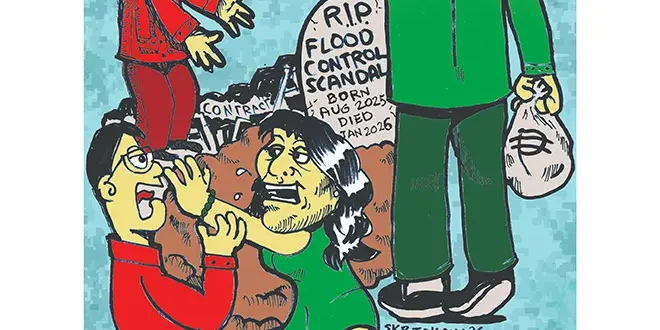
Philippine politics has once again proven that when accountability knocks, distraction answers the door.
The recent verbal skirmish between Senators Ping Lacson and Imee Marcos—sparked by the latter’s insinuation that Lacson wears a wig and is gay—was comic relief of the lowest order, a word-war better suited for a schoolyard than the Senate floor. Yet it succeeded in doing what Philippine political theater does best: divert attention. The exchange was soon eclipsed by another clash, far less amusing but far more consequential, involving multi-billionaire Enrique Razon and suspended Cavite Rep. Francisco “Kiko” Barzaga.
In a now-viral Facebook post, Barzaga accused Razon of bribing lawmakers belonging to the National Unity Party to support former House Speaker Martin Romualdez. The response was swift and crushing. Razon filed a ₱110-million cyberlibel complaint against the young lawmaker—an unmistakable warning shot about the cost of challenging power. Whether the allegation is true or reckless remains for the courts to decide, but the imbalance is unmistakable: a billionaire’s legal artillery versus a suspended congressman’s Facebook post.
As these spectacles unfold, the country drifts further away from the resumption of investigations into anomalous infrastructure projects—particularly the flood control scandal that has already submerged billions of pesos in public funds with little to show but submerged communities. Conveniently timed distractions continue to pile up.
Foremost among them is the impending re-filing of an impeachment complaint against Vice President Sara Duterte. Despite the controversies surrounding her office, she remains the early frontrunner in the 2028 presidential race—unless impeachment succeeds in dislodging her.
Senate President Tito Sotto has pledged to act “with dispatch, forthwith” once a verified complaint is transmitted by the House. History, however, suggests that speed in impeachment is often selective, dictated more by political arithmetic than constitutional urgency.
As if that were not enough, whispers of a separate impeachment complaint against President Ferdinand Marcos Jr. are growing louder, anchored on alleged manipulations of the national budget in prior years. Whether these efforts are serious or merely tactical maneuvers to muddy the waters remains unclear. What is clear is their effect: they further fracture public attention and exhaust civic outrage.
Lost in this political carnival is the flood control scandal itself. The Department of Justice is reportedly preparing to release a list of individuals who qualify as state witnesses—potentially absolving them of liability altogether. The Independent Commission on Infrastructure, already weakened by the resignation of two of its three commissioners, is said to be on the brink of disbandment. Accountability, once again, appears negotiable.
The pattern is disturbingly familiar. Like the Priority Development Assistance Fund scandal a decade ago, the narrative seems destined for a convenient ending: a minor player jailed, the architects untouched, and the public encouraged to move on. Case closed—not by truth, but by fatigue.
In Philippine politics, scandals do not die from resolution. They die from neglect, buried under louder, flashier controversies. And in that sense, the system works exactly as intended—for those it was designed to protect.