 The Market Monitor Minding the Nation's Business
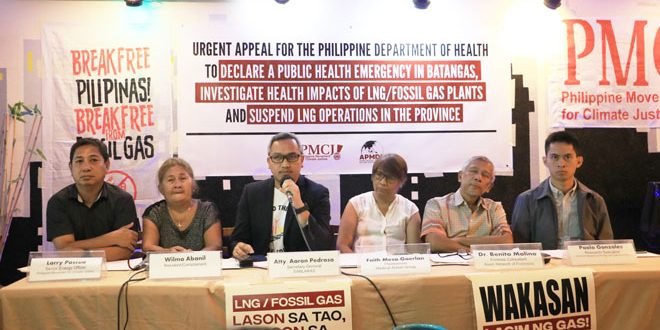
Several groups and individuals raised serious concern recently about the health impacts of liquefied natural gas (LNG) on the residents of Batangas City, as they urged the Department of Health (DOH) to declare a public health emergency and investigate the matter.
Members of the Philippine Movement for Climate Justice (PMCJ), in partnership with the Asian People’s Movement of Debt and Development (APMDD), stepped forward to call the health department’s attention and action following the alarming hike in the prevalence of diseases related to LNG exposure in several communities in the city.
The Philippines currently has six LNG power plants, five of which are in Batangas. The five communities that host these facilities—Ilijan, Malitam, Sta. Rita Karsada, Tabangao Ambulong, and Tabangao Aplaya—have reported increased cases of respiratory and cardiovascular diseases, with a rate going as high as 1 per 10 individuals based on data from the Batangas Health Office.
Earlier this year, the said communities filed for a petition for the DOH to investigate the health effects of these LNG plants on nearby residents but have not gotten any action from the health department to date.
In their campaign, the PMCJ cited that LNG’s primary component, methane, has been proven to have harmful effects on health over time. This was an issue raised by the DOH itself during the recent Senate hearing Philippine Downstream Natural Gas Industry (PDNGI) Development Act, which aims to secure local sources of LNG in anticipation of the depletion of the Malampaya gas field.
LNG operations, the group said, also pose a threat to the environment as it is a greenhouse gas that is 86 times more potent than carbon dioxide. Global temperature rise will make the ocean inhospitable to marine life.
Furthermore, LNG infrastructure displaces coastal communities and destroys marine habitats, as was stated by Verde Island Passage advocates in their recent call to stop coastal reclamation projects in Batangas.
The PMCJ added that the continuation of LNG operations is a direct hazard both to public and environmental health.
PMCJ National Coordinator Ian Rivera emphasized the role of media in bringing this health emergency to fore: “Hindi lang ordinaryong statistika ang mga taong apektado. Sila ay pamilya at kababayan natin. Sa pagkakataong hirap silang magsalita dahil di sila makahinga, tayo ang magsalita para sa kanila.”