 The Market Monitor Minding the Nation's Business
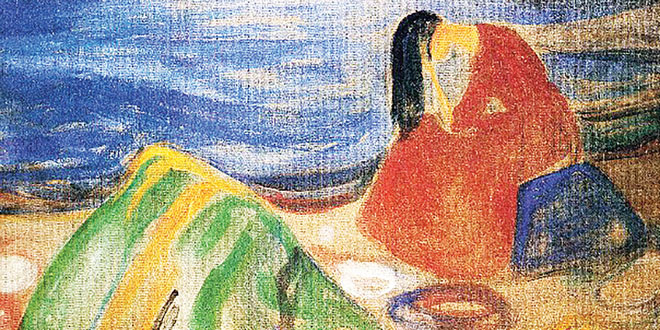
 She had turned into a stranger, altered beyond recognition. If not for her eyes that still flashed from a pale violet to purple when she fumed, I would have had no way of knowing who it was that answered to her name—she writhed in constant pain, moaned and sniffled quite often.
She’d call me at random hours; whining about innocuous details such as the daffodils rain had battered. “I’m growing crow’s legs,” she said, one evening as she shuffled to her kitchen. Her housecoat had weighed down her body as if it were a chain mail. Pain wracked her, but no wound, fracture, or tumor confirmed a source. Yet, she had stomach cramps, at times, agonizing back pain, or a hammering headache.
One evening, what felt like a heart attack so alarmed neighbors that one had dialed 911, and later, watched how gently the first responders calmed her down. Fear, anger, resentment, and memories had gouged her insides; none of her pain relieving pills seemed to work, while the phantom within her kept chipping off parts of her. It’s been taking her hours to get ready for what once were mere routines like lunch or hair appointments; she used to arrive anywhere a quarter of an hour before anyone did.
While to the onlooker, symptoms of mood and/or anxiety disorder had affected her—a condition in varying degrees of seriousness like depression and bipolar disorder, some leading to suicide, reported among 3 million Canadians in 2013—her doctor discounted it, shielding her from dreaded often irreversible changes that isolate victims from lack of understanding, prescribing acetaminophen and antacids for her pains, instead, prudently suggesting massage therapies for knotted muscles, and a conversation with a psychiatrist; apparently, so I learned later, telling her none of it is real would drive her deeper to despair.
I had walked into her apartment some evenings when she needed me most and take the Chippendale rocker from across her on the couch. Once, as in the 365 nights since her marriage suddenly turned on her—a Diablo who rent her being, whose arms uncoiled and vise-like gripped her, whose fists fell like volleys on target, most painful of all, it had felt, on her heart—we revisited old vistas. We sneaked into these, un-barred by time or space, her head propped on Victorian needlework encased cushions, a red velvet blanket drawn to her waist. Lamps that glowed from a faux marble table would cast us in a changeless scene— the heart and its volatile landscapes.
Tossed in a see saw of feelings, she would talk of landmarks that lovers make of ordinary spaces—a park by the beach, where she loved to swing, her husband pushing her closest to kick the sky, as well, a sunset-washed dinner place tucked in a cliff-side cove, and as if from a deep sigh, her cathedral wedding with her robust garlic bouquet that invited moon-smiles—moments encrusted in her heart. But none of that would last because soon, she would freeze as the grandfather clock ‘bonged’ the hour, exactly, when the gyre cranked and broke, that year she found an intruder’s footprints in his distant gaze, and in the spaces he began to clear for himself; she could still hear her own animal cry, like it slashed the heart, pummeling its cave. With a pained twitch and a pained stare, she would flit away, the stranger taking her place in the couch once more.
I often begged her to look out to the patio—she kept the blinds drawn. Look, I would say, how spring has returned the same it had in the forty-six years you had lived in this hemisphere, how dead winter that you dreaded has slinked away—summer will again push the cold to no-memory. But she remained blind to anything beyond where her heart dwelt right then.
None of this melodrama really figured out in her divorce proceedings. As in many cases, most of it have been walled-in realities, except, of course, among celebrities as in the latest between Brad Pitt and Angelina Jolie, a shock to whoever cares and serving as fodder for media, when the truth bursts.
As for me, her case mirrored my own vulnerability. I had shared with her my loss, too, not by divorce but by widowhood, and how I waited to die until I woke up one day to find that I couldn’t, but in the vastness where I fell, I found the center where change is eternal. Recasting words, I would speak to her of faith. She had stared at me, seeing the empty space she laid out for herself with her obstinate heart.
It has taken her ten years to tackle her pain and grief that caused the invisible wounds—indeed, except for actual cuts, lacerations, and stabs, such white ghosts harbored in the heart could deepen and grow prurient. As Time had proven for her, on her own and with faith, and not from opioids that alone are known to dull the deepest of pain, she has recovered whom she once lost.