The Market Monitor Minding the Nation's Business
By Joni Gesmundo
Mexican Independence Day is a celebration that brings the entire nation together in a display of unity, pride and tradition. Every September 16, Mexico commemorates one of the most pivotal moments in their history—emancipation from Spanish rule. Unlike Cinco de Mayo, which is often confused with this holiday, Mexican Independence Day marks the true beginning of the country’s sovereignty.
The movement began in 1810 with a historic call to arms by Don Miguel Hidalgo y Costilla, a Catholic priest, who rang the bells of his church in Dolores Hidalgo and urged his countrymen to stand against the oppressive colonial powers. This moment, known as the “Grito de Dolores,” sparked an 11-year struggle for freedom that ultimately ended with Mexico’s independence in 1821.
Celebrations begin on September 15, with a reenactment of Hidalgo’s famous cry for independence. From Mexico City to small towns across the nation, crowds gather to witness the president or local leaders shout, “¡Viva México!” The energy is electric as the sky lights up with fireworks, and the streets are alive with parades, live music, and street vendors selling traditional food. The patriotic colors of green, white, and red are everywhere, reflecting hope, unity, and the sacrifices made for freedom.
“Grito de Dolores” is usually not the same every year but its essence remains consistent. Each leader brings a unique touch to the cry, adding a personal connection to the historical moment. The story of Mexican independence is also full of unsung heroes, like Doña Josefa Ortiz de Domínguez, a brave woman who secretly supported the insurgents and played a key role in their plans.
Celebrating Mexican Independence Day is more than just a party. It’s a reminder of the country’s resilience, bravery, and the unbreakable spirit that allowed Mexico to become a free nation. Whether in Mexico or abroad, especially in cities with large Mexican communities, this day is a moment to honor history while enjoying the vibrancy of Mexican culture.
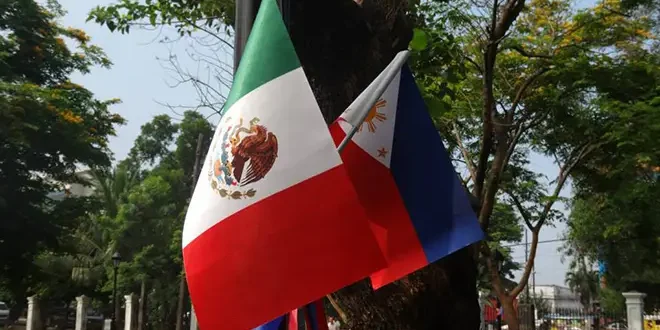
Philippine-Mexico relations
The recorded history between Mexico and the Philippines goes back almost 500 years. Following Magellan’s demise, the first Spanish expedition to the Philippines was led by Ruy Lopez de Villalobos. His 400 men sailed from Jalisco in November 1542, not from Spain, as many believe. Villalobos was responsible for naming our islands “Filipinas.”
Another expedition from Mexico set sail to the Philippines in 1565, this time lead by Miguel Lopez de Legazpi. Legazpi was a Spaniard who was then the Governor of Mexico City. Legazpi landed in Cebu to claim the Philippines as a Spanish colony.
In 1571, Legazpi designated Manila as the colonial capital of the Philippines under the Spanish crown. The Philippines was governed not by Spain itself, but through the Viceroy of Nueva España (Mexico). The Manila-Acapulco Galleon Trade was at the heart of Philippine-Mexican relations. Within a span of 250 years, both colonies thrived from a virtual monopoly of Pan-American trade. A mixture of cultures, ideas and customs flourished.
The lucrative trading route ended in 1815 when the Mexican War of Independence ended Spain’s control over Mexican ports. But not even the termination of the Galleon trade could get in the way of the cooperation between Mexico and the Philippines. In fact, two Filipinos — Francisco Mongoy and Isidro Montes de Oca — fought alongside Vicente Ramón Guerrero, the leading revolutionary generals in the Mexican war for independence. Hence, it could be said that the Philippines helped Mexico gain its freedom.
After Mexico seceded from Spain in 1821, Spain tried to cut ties between the Philippines and Mexico lest the idea of revolution spread among Filipinos. It was only then that the Philippines was governed by Governor Generals coming directly from Spain. Sometime in the 1820s, Vicente Ramón Guerrero was quoted as saying: “Now that we have gained our independence, it is our solemn duty to help the less fortunate countries, especially the Philippines, with whom our country has the most intimate relations with.” The Philippines freed itself from Spanish colonial rule 67 years later.
Like a Mexican telenovela, Mexico’s journey towards economic prosperity came with peaks, troughs, and drama. It started with a policy of import substitution that took place from the 1930s to the 1970s. The policy worked and Mexico experienced an economic boom where industries rapidly expanded. The Mexican population doubled from 1940 to 1970 while GDP increased sixfold.
Mexico began to harness its oil reserves in the ’70s and readily became the world’s 4th largest exporter of the commodity. Wealth generated from oil allowed massive spending on infrastructure and social development programs.
The plunge in oil prices in the late ’70s and early ’80s resulted in a severe economic downturn for Mexico. In 1981, President Jose López Portillo suspended payments of foreign debt, devalued the currency and nationalized the banking system. Exacerbating the situation was the fact that import substitution and protectionism left many Mexican industries inefficient and unable to compete in the global marketplace.
Mexico needed to reinvent itself — it needed to build competitive industries and wean itself from dependence on oil. It was at this time that President Miguel de la Madrid opened the economy to free trade. Deregulation and the privatization of industries followed including the state-owned oil company, PEMEX. From an oil-driven economy, Mexico transformed itself into manufacturing and agro-industrial force through capital and technologies obtained from foreign investments. It was in this time that Mexico became a signatory to the General Agreement on Tariffs and Trade (GATT).
A turning point came when Mexico became a signatory to the North American Free Trade Agreement in 1992. Due to affordable wages and the high productivity of Mexican workers, Mexico was the preferred site for most Canadian and American manufacturing concerns. Throughout the ’90s, industrial outputs grew steadily as did exports despite political instability such as the Chiapas Uprising, the assassination of presidential candidate Luis Donaldo Colosio, and the massive devaluation of the peso. The Mexican economy grew by 5.1% from 1996 to 2000 as trade with the US and Canada tripled.