 The Market Monitor Minding the Nation's Business
By Rose de la Cruz
Just when things looked bright for the Mindanao Railway Project during the Duterte administration, but turned sour with Chinese funding withdrawn, the project is currently being overhauled and reviewed by the Department of Transportation, this time to prioritize the development of a modern and environment-friendly rail system in the southern Philippines.
The plan to put up a railway in Mindanao began in 1936 during the time of President Manuel L. Quezon previously known as the Trans-Mindanao High Speed Railway and upon completion to be named Eagle Express, to strengthen the presence of the Commonwealth government in the south against the rising influence of Imperial Japan before the war.
The line was shelved and other proposals and studies were done in 1950s, 1990s and 2000s but never materialized. The current line began development in 2018 but co nstruction has yet to start, first as a single-track standard gauge system to be operated by diesel-powered rolling stock but with provision for double-track and electrification through overhead lines.
“We need to finalize the [feasibility] study. The Mindanao Railway’s original study proposed the use of diesel-powered trains… but, if we want to build a new system, we should adopt a more modern and environment-friendly technology,” Transportation Secretary Jaime Bautista told GMA 7 Integrated News..
He also said the DoTr will overhaul the entire project. ““Our consultants are already doing it,” Bautista said, adding that the study will be completed within the Marcos administration.
DoTr in February began construction activities for the project beginning with land acquisitions along the target alignment and identified resettlement sites for displaced residents.
Pre-construction works were commenced despite the ongoing search for the funding sources of the project.
Bautista said the DOTr is coordinating with the Department of Finance to look for potential funding.
On September 22, 2023, then-Finance Secretary Benjamin Diokno sent a letter to Chinese Ambassador Huang Xilian informing him that the country would no longer pursue loan financing for the MRP from China.
Bautista confirmed this during the German-Philippine Chambers of Commerce and Industry forum in October 2023, stating that the agency dropped the Chinese ODA as a funding source for the MRP and two other railway projects having reached “no development” in negotiations.
DoTr is now eyeing ODAs from other countries and multilateral financial institutions for funding.
In 2021, it was indicated that the construction of the railway project’s Phase 1 will begin in the second quarter of 2022 and is targeted to be partially operable by the latter part of the year.
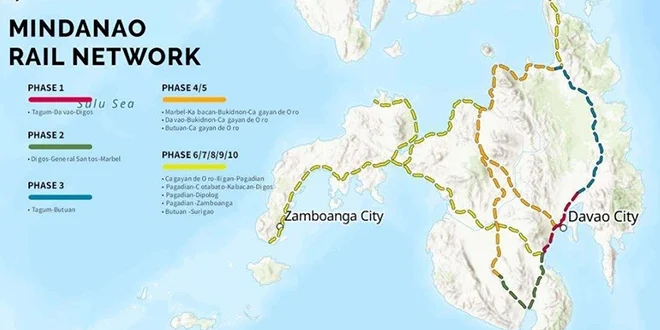
The Phase 1 of the project has a length of 100.2 kilometers with over eight stations and an estimated project cost of P81.6 billion.
The Mindanao Railway was originally set to begin construction for its phase 1 or Tagum-Davao-Digos segment in January 2019.
The railway in its present form began development in the late 2010s. While JICA was conducting initial studies, then-presidential candidate Duterte supported the construction of the railway. Upon his election, he aimed to begin construction of the first phase between the cities of Tagum and Digos by 2017 and open it partially before the end of his term in 2022. In 2018, the project, initially called the Trans-Mindanao High Speed Railway, was approved and received initial funding from Congress. The rest of the funding would have come from China’s ODA.
Construction was delayed after several eminent domain issues from residents of a high-end gated community near Davao City asking DoTr to realign the railway line to avoid hitting an 18-hole golf course.
The railway’s route was modified into a system centered around a circular mainline but later reverted to the old right-of-way but now incorporates the extensions and branch lines featured in the 2019 proposal. In its current state, the project has 18 segments to be divided into 10 phases.
On March 24, 2021, the DOTr Undersecretary for Project Implementation in Mindanao, Eymard Eje, Tagum mayor Allan Rellon, and Carmen mayor Virginia Perandos signed a deed of absolute sale for land to be used for the construction of the Tagumpay Train Village, a resettlement area for families affected by the project. As of April 2021, land acquisition from Panabo to Carmen was almost complete. On April 19, 2021, the city government of Panabo issued an ordinance prohibiting any unrelated construction on the right-of-way of the Mindanao Railway.
The Project Management Consultant Contract for the Tagum–Davao–Digos segment of the project was signed on October 20, 2021. It was also announced that the final length of the system would be 1,544 km (959 mi).