 The Market Monitor Minding the Nation's Business
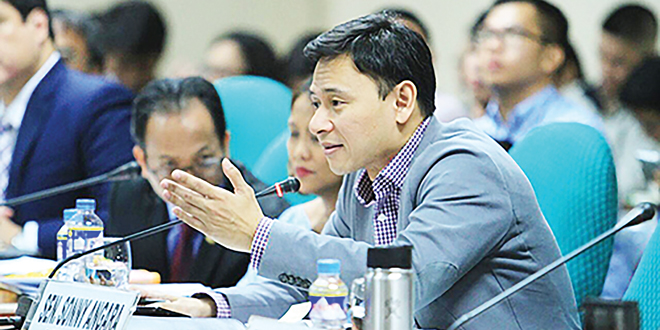
The Senate is giving priority to the Comprehensive Tax Reform Program (CTRP) being sought by the government through the Department of Finance (DOF) and cannot at this time accede to the House of Representatives’s request for a needed push to amend the Sin Tax Reform Law, commonly known as the sin-tax law, said Sen. Juan Edgardo “Sonny” Angara, chairman of the Senate Committee on Ways and Means.
Earlier, the senator said the Senate would have to review the overall impact of the sin tax law on both revenue collections and public health.
In a hearing last Tuesday on the House proposal to revert to a two-tier excise tax on cigarettes under the sin tax law, senators said they were not convinced of the rationale presented for the House proposal. Angara himself said he saw was no urgency in having it passed.
The senator said that in 2015, the government collected P99.5 billion in tobacco excise tax alone, which was half a billion lower than the previous year. “Then in 2016 it went down to P91 billion, or P8 billion lower. Each year, the tax rate increases. So any change in the tax structure may affect collections.
We all know that proceeds from the sin tax are used as funds for Philhealth, universal healthcare premiums,” he said. The senator said there could also be a tedious debate when the measure is put on the floor due to the concerns of health advocates.
Under the House-approved bill to amend the sin tax law, two new increased tax tiers, one at P32 per pack for locally made cigarettes and the other at P36 per pack for foreign brands were proposed. An annual increase of 5 percent on the rates was also provided.
The bill sought to protect the welfare of local tobacco farmers by maintaining the current excise tax system on the cigarette packed by machine to two tiers instead of shifting to unitary excise tax rate in 2017. The current sin tax on tobacco sees a unitary rate of P30 per pack in 2017, with an annual four percent adjustment thereafter. “There are those who seek to balance health and revenue.
There are those who couldn’t care other way, they’re just looking at the actors perhaps. What is good with the current sin tax law is that there is a built-in amendment every year.
There’s a built-in increase of 4 percent so even if we don’t amend it, government collections are expected to go higher,” Angara said. Angara gave assurances assured there would be no railroading of the bill in the Senate. “We listen to all stakeholders and I think senators are mature enough to make their judgments based on data and objective reason,” he said.
Angara said the income tax reform needed more urgent legislative action because the income tax structure had not changed for the past 20 years, “unlike the sin tax, which changes every year.”
He cited a provision in the sin tax law providing for the excise tax system on alcohol and tobacco products indexed on the inflation rate. “The sin-tax amendments are not as urgent as amending the income tax because the government still makes money whether we amend it or not,” he said.
Finance Assistant Secretary Paola Alvarez, meanwhile, called on critics of the CTRP to come up with an alternative tax plan that could make the current system and fairer to low-and middle-income taxpayers, while at the same time raising enough revenues to fund an ambitious government program to free some 6 million poor Filipinos from poverty and transform the country into a high-middle income economy by 2022.
Alvarez, also the DOF spokesman, said that while she agrees with critics that implementing tax administration reforms in the bureaus of Internal Revenue and Customs would, indeed, increase revenue collections, such higher collections would not be sufficient enough for the Duterte administration’s unprecedented public investments in infrastructure, human capital development and social protection for the poor and other vulnerable sectors over the next six years.
Moreover, the current complex system of filing taxes, which abets corruption and often discourages the payment of taxes, leads to non-compliance and massive collection leakages costing over P100 billion per year, Alvarez also said. “For example, with 59 lines of exemptions in the value-added tax (VAT) compared to around 30 in other Asean countries, it is not surprising that we have the lowest collection effort despite having the highest VAT rate.
Our tax reform seeks to correct this,” Alvarez said. “The simpler the tax system, the more efficient and equitable it is, the easier to collect and stamp out corruption and tax evasion. In this regard, both tax policy and tax administration are our priorities,” she added.
The first package of the DOF’s CTRP—as contained in House Bill No. 4144 authored by Rep. Dakila Carlo Cua, aims to lower personal income tax (PIT) rates and reduce donor and estate taxes, while adjusting fuel and automobile excise taxes and expanding the VAT base but retaining exemptions enjoyed by senior citizens and persons with disabilities, among other reform measures.
Cua chairs the House Committee on Ways and Means, which has started public hearings on the different components of the CTRP’s Package One. Various groups and sectoral leaders have already expressed their support for this tax reform plan.
Alvarez said the CTRP is needed to raise sufficient revenues over the medium term, because the Duterte administration would actually need an additional P1 trillion each year, on top of the current P1.2 trillion, to ramp up spending on infrastructure, education and training, health, social protection and welfare and job generation, which are crucial to pulling down the poverty rate from the current 21.6 percent to 14 percent by 2022.
“We welcome criticisms and challenge critics to provide us a coherent and sustainable revenue-generating program that would be efficient and fair for everyone,” Alvarez said. “The DOF will more than welcome sound suggestions aimed at reducing poverty and providing us lasting solutions to the country’s massive infrastructure gap,” she added.
The country’s poor infrastructure has for decades dulled the country’s regional competitiveness as a destination for foreign direct investments, huge inflows of which are essential to boosting economic activity and creating more jobs, she said.
Based on estimates by the Department of Budget and Management, the total infrastructure budget–both national and local—will grow from P861 billion in 2017 to P1.898 trillion by 2022, or from 5.4 percent to around 7.0 percent of the country’s Gross Domestic Product (GDP).
The government would need around P8 trillion to P9 trillion in infrastructure investments between and 2022 to fulfill the Duterte administration’s promise of high and inclusive growth, Alvarez, citing DBM data, said.
Alvarez said “The CTRP aims to provide inclusive growth that would lay down the foundation for the country to be an upper middle-income country like Thailand by 2022 and a high-income country like Malaysia by 2040.”
In response to claims that the government need not impose new taxes or increase existing ones because of the windfall of P900 billion in Official Development Assistance obtained by the Duterte administration from China and Japan alone, she pointed out that such an amount would not be enough to fund the government’s massive spending strategy that will cost an estimated P8 trillion to P9 trillion.
Alvarez said “the Duterte administration is steadfast in its vision to eradicate extreme poverty and bring the country to prosperous-nation status in one generation. Clearly, our business-as-usual approach to raising revenues is no longer viable. We need to do far more if we want our poor countrymen to at last feel the benefits of growth and, eventually, graduate from poverty.”
Critics have insisted that the DOF should just agree to the lowering of the income tax rates, without pursuing the other measures necessary to raise the additional revenues the Duterte administration’s public investment program.
But Alvarez said doing so would be anti-poor because merely lowering PIT rates would lead to massive revenue losses, leaving the government with scarce funds for health, education, and social protection, which are vital elements in reducing poverty and improving the living standards of the Filipino majority.