 The Market Monitor Minding the Nation's Business
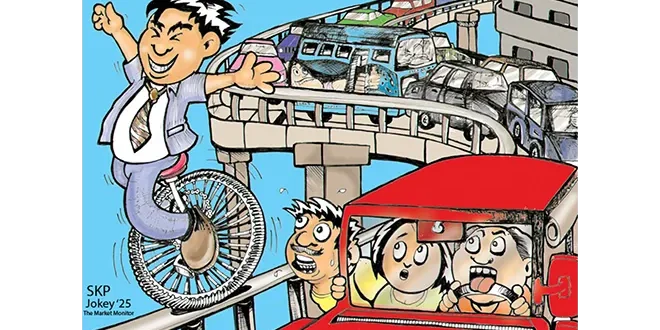
President Ferdinand Marcos Jr.’s vision to move away from a transportation system dominated by private cars is a long-overdue step toward a more efficient, inclusive, and sustainable urban mobility network.
As newly-appointed Department of Transportation (DOTr) Secretary Vivencio “Vince” Dizon emphasized, this shift signals a renewed commitment to prioritizing public transport, pedestrian infrastructure, and alternative mobility options over the traditional car-centric model that has long plagued the country’s urban centers.
For decades, Metro Manila and other major cities have suffered from crippling traffic congestion, exacerbated by a transportation policy that favors private vehicles.
Roads are constantly clogged, air pollution levels continue to rise, and productivity losses due to traffic gridlock cost the economy billions of pesos annually.
The solution lies not in building more roads for cars but in developing a robust, efficient, and accessible public transport system that encourages Filipinos to leave their cars at home.
Investments in mass transit systems, such as railways, bus rapid transit (BRT), and modernized jeepneys, must be prioritized to provide commuters with reliable and affordable alternatives.
The Philippine National Railways (PNR) North-South Commuter Railway, Metro Manila Subway, and the expansion of the Light Rail Transit (LRT) and Metro Rail Transit (MRT) systems are promising projects that align with this vision.
However, their completion must be expedited, ensuring that they serve the growing commuting population effectively.
Equally important is the promotion of non-motorized transport such as cycling and walking. Many progressive cities worldwide have already reallocated road space for protected bike lanes and pedestrian-friendly zones.
The Philippines must follow suit by creating safe, well-designed infrastructure for cyclists and pedestrians, reducing dependence on motorized transport while promoting healthier and greener urban environments.
Of course, a paradigm shift of this scale requires not only infrastructure development but also strong policy reforms.
The government must review existing road-use policies, enforce traffic regulations that discourage excessive private car ownership, and promote transportation demand management strategies such as congestion pricing and improved parking regulations.
Public transport should be the backbone of mobility in the country. If properly implemented, this shift will not only ease congestion but also reduce carbon emissions, enhance economic productivity, and improve the overall quality of life for millions of Filipinos.
President Marcos Jr.’s commitment to a less car-centric transportation system is a welcome move, but it must be matched with decisive action, sustained funding, and a whole-of-government approach.
If the administration stays the course, the Philippines may finally achieve a transportation system that prioritizes people over vehicles, efficiency over exclusivity, and sustainability over short-term fixes.