 The Market Monitor Minding the Nation's Business
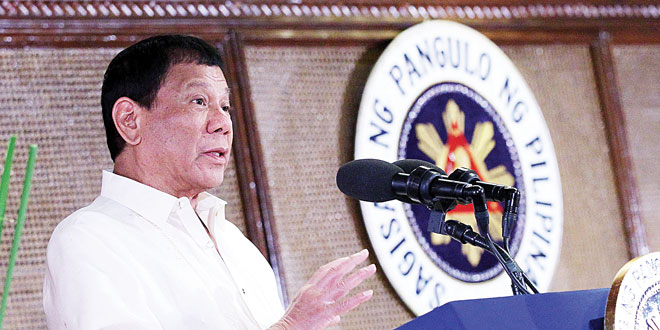
By Luis Leoncio
Efforts to oust President Duterte, whether it be through the impeachment process or a military takeover, will remain futile due to the continued high popular support on Mr. Duterte, the US-based strategic forecasting firm Stratfor said.
The report “In the Philippines, The Punisher Takes a Beating” stated that challenges to Mr. Duterte’s hold on power “are unlikely to gain momentum while he remains broadly popular.”
It warned, however, that China’s unrelenting attempts to extend its maritime boundaries will complicate its detente with the Philippines and undermine Duterte’s political support at home.
Stratfor said nine months after surging into office on a wave of popular support, Mr. Duterte stands on “shaky ground as he pushes ahead with his controversial agenda.”
At home, Mr. Duterte’s brutal campaign against drug dealers and crackdown on corruption among bureaucrats and police forces are still widely supported by Philippine citizens, it said.
It added that despite the strong support on him, extrajudicial killings, which so far have claimed around 8,000 lives, have begun to draw criticism from the Catholic Church, civil society groups and Western governments.
“His political opponents have seized upon the condemnations, along with his threats to impose martial law, to try to mobilize the public against his young administration,” it noted.
The Stratfor report added that attempt to overhaul Manila’s foreign policy is not going much more smoothly.
It cited Mr. Duterte’s attempt to spearhead a detente with China while pulling back from close ties with the United States which Stratfor said is being undermined by Beijing’s creeping maritime claims and “Duterte’s own conflicting statements.”
This has raised accusations that Duterte is compromising the country’s sovereignty for economic gain and put the president somewhat at odds with the country’s military and foreign policy establishment, including, at times, his handpicked leaders of the Department of National Defense (DND) and Department of Foreign Affairs (DFA).
The report said for now, at least, the consternation building against Duterte is not enough to hamstring him.
“His overwhelming popularity, control of Congress and support among the Philippines’ biggest political power brokers will enable him to fend off any threats to his rule, including a recent impeachment bid submitted by a member of the opposition,” Stratfor said.
It added that overall, Duterte still commands support from the military, which is a necessary ingredient in any takeover attempt.
“Despite the occasional rumor of a coup in the making, the military for the most part still supports the president, and is far too fragmented to take action against him without broad, grassroots push for his removal,” the report said.
“Nevertheless, as a political outsider who is still working to consolidate power across the fractured country, Duterte will have to take care to ensure that his populist theatrics and devil-may-care diplomacy do more to advance his contentious policies than stall them,” it said.
A good part of the report touched on Mr. Duterte’s efforts to reach out to China, which Stratfor said may not realize his expected results.
“Though Duterte’s ruthless counternarcotics campaign continues to earn him points with the public, his foreign policy tactics have begun to backfire. On March 8, Defense Secretary Delfin Lorenzana revealed that Chinese survey vessels repeatedly engaged in unauthorized activities near the Benham Rise last year,” it said.
Benham Rise is located east of Luzon, which is beyond the territories traditionally disputed between China and the Philippines. The area is believed to be rich in mineral and natural gas deposits.
A United Nations (UN) commission confirmed that Benham Rise is part of the Philippines’ extended continental shelf in 2012, effectively giving Manila exclusive rights to exploit hydrocarbon and mineral resources on the underwater plateau.
Stratfor said recent revelations about China deploying a research ship in the region has raised concerns that Beijing may not honor the ruling much longer.
“Duterte’s subsequent claim that Manila had permitted the vessels’ research — a direct contradiction of the statements made by his defense and foreign affairs officials — only increased the public’s misgivings,” it said.
It added that what made matters worse, was a local Chinese official who suggested that Beijing plans to build a monitoring station on the Scarborough Shoal, the submerged rock that once lay at the heart of Manila’s maritime dispute with its northwestern neighbor.
“Though the Chinese Foreign Ministry denied the validity of the remark a few days later, it did little to ease the anxiety spreading throughout the Philippines,” it said.
“At first Duterte’s unorthodox approach to diplomacy seemed to have paid off, particularly as the rise of a new administration in the White House called into question Washington’s Asia-Pacific policy,” Stratfor said.
It added Mr. Duterte’s newfound friendship with China has already yielded a multibillion-dollar economic deal that includes much-needed infrastructure investment, aid and trade pacts.
“At the same time, he has boosted the Philippines’ economic and defense ties with Japan and Russia, all while maintaining the protection and power that an alliance with the United States provides.
But as the latest incidents have shown, Duterte’s success is by no means certain to last forever,” it said.
Stratfor said striking a delicate balance between great powers such as the United States and China requires room to maneuver and a high tolerance for risk.
“After all, the economic benefits of deals reached with Beijing will take years to materialize, and there is no guarantee that they will fulfill Duterte’s promise to deliver sustained and equitable growth to the Philippine economy,” it said.
“Unlike in his more popular drug war, moreover, Duterte will not be able to count on the public’s backing to shield his foreign policy initiatives from military, legislative or judicial scrutiny, particularly if he is perceived to be trading Philippine sovereignty for Chinese trains and trade,” it added.
It said already wary of Duterte’s determination to cooperate with China, the Philippine defense establishment and population have grown all the more suspicious of Beijing’s incursions into previously untouched waters.
“And so, Duterte’s options are gradually narrowing. Manila understands that it cannot check China’s unrelenting ambitions in the Pacific or rely on Beijing’s goodwill to preserve its maritime claims, just as it cannot afford to alienate Washington to the point of breaking its alliance with the United States,” Stratfor said.
It said the president’s choices will be constrained by public sentiment and powerful stakeholders across the political spectrum.
“And if his popularity starts to notably decline, the most ambitious items on his agenda will be put in jeopardy,” it said. Stratfor said to some extent, Duterte’s predicament reflects the Philippines’ larger geopolitical dilemma.
“Burdened by a weak state, the island nation has struggled to maintain its unity, protect its territorial integrity and guard against external threats. Yet, located at the heart of the Pacific Rim — and the center of the South China Sea dispute — Manila has long sought to leverage its geographic advantages for domestic gain,” it said.