 The Market Monitor Minding the Nation's Business
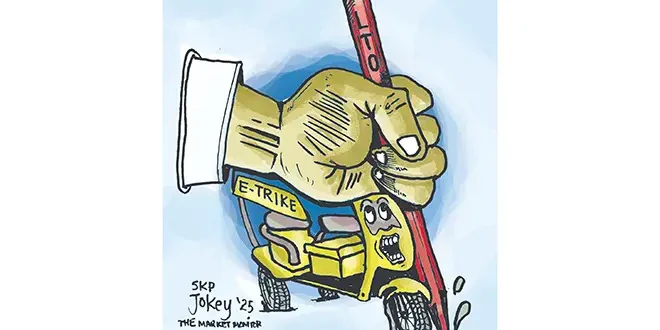
The Electric Vehicle Industry Development Act (EVIDA) of 2022 was enacted to promote the adoption of electric vehicles (EVs) in the Philippines, reduce dependence on fossil fuels, and democratize access to cleaner transportation. Yet barely years into its implementation, the Land Transportation Office (LTO) appears to be undermining both the spirit and the letter of the law by pushing to ban e-trikes from major roads in Metro Manila—ironically in the name of road safety.
E-trikes, a class of electric vehicles explicitly covered and encouraged under EVIDA, have emerged as a practical and affordable transport option for ordinary Filipino households. Unlike luxury EV sedans such as Tesla or BYD models—still firmly within the reach only of the wealthy—e-trikes opened the door for mass adoption of electric mobility. They represent exactly what EVIDA envisioned: inclusive, sustainable transportation.
LTO’s justification, however, raises more questions than it answers. Citing road safety concerns, the agency seeks to restrict e-trikes from major thoroughfares. Yet recent statistics consistently show that the vast majority of road accidents in Metro Manila involve motorcycles, most of them petroleum-fed. If the LTO’s logic were applied consistently, motorcycles should face equal—if not stricter—limitations on highway access. But they do not. Instead, motorcycles remain largely unencumbered, while e-trikes are singled out for heavy-handed regulation.
This selective enforcement smacks of inconsistency and invites suspicion. Is road safety truly the issue, or is it a convenient pretext? One plausible explanation is that commercially used e-trikes are being targeted because they compete with traditional tricycles—the long-standing “kings of the side streets.” Rather than modernizing and integrating new transport technologies, regulators seem intent on protecting the old order.
Equally troubling is the LTO’s argument that unregistered e-trikes pose a danger to public safety. Registration is necessary, yes—but to suggest that registration alone prevents road deaths is disingenuous. Accidents are caused by reckless driving, poor road design, weak enforcement of traffic rules, and lack of proper driver education. None of these problems magically disappear with a registration sticker.
The LTO’s approach reflects half-baked regulation: restrictive, poorly reasoned, and detached from broader transport realities. Such measures not only contradict EVIDA but may also be vulnerable to legal challenge. Regulatory agencies are meant to implement the law, not subvert it through arbitrary bans.
No one is arguing against regulation. Sensible standards on speed, vehicle design, road-worthiness, and driver training are necessary to ensure safety. But regulation should enable growth, not choke it. Singling out e-trikes—one of the most promising and accessible EV solutions for ordinary Filipinos—risks derailing the country’s transition to cleaner transport.
If the government is serious about road safety and sustainability, it must regulate fairly, think coherently, and honor the laws it proudly passed. Otherwise, EVIDA risks becoming another well-intentioned reform undone by the very institutions tasked to uphold it.