 The Market Monitor Minding the Nation's Business

Regulatory compliance: a key sustainability driver and a challenge
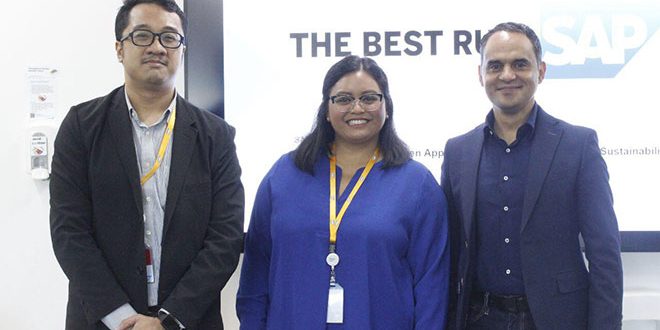
In a recent media event held by SAP at its headquarters at the NAC Tower, Bonifacio Global City in Taguig, Rudy Abrahams was joined by Apple Evangelista, Head, Sustainability and Social Responsibility (SSR) of Globe Group and Henrik Batallones, Marketing and Communications Director of the Supply Chain Management Association of the Philippines (SCMAP) to discuss how organizations have been refocusing their strategies to ensure sustainability.
“In the Philippines, organizations used to consider sustainability as a cost tied to regulatory compliance. But that perspective is changing. Sustainability is now seen as a strategic imperative to ensure that organizations not only provide better service to their customers but also help ensure a sustainable future,” said Batallones.
SCMAP is the premier supply chain industry organization in the country. Comprised of some of the country’s major manufacturers, logistics providers, and retailers, SCMAP engage with stakeholders in the public and private sectors, advancing supply chain education on all levels, and organizing events that provide a venue for supply chain professionals to connect towards global competitiveness of the industry.
Meanwhile, citing the data from the SAP and Oxford Economics report, Abrahams noted that organizations in the region consider compliance as the second biggest sustainability challenge (26 percent), only behind reinventing business strategy. This means that organizations in the country may need to refocus on their strategies to achieve greater value and benefit from sustainability.
Investing in data, improving sustainability outcomes
Key to improving sustainability outcomes will be the effective use of organizational data to make more informed decisions. For businesses in the Philippines, this remains a challenge as it takes time, especially for organizations like Globe, which has various entities with different processes and reporting formats.
To address this challenge, Globe has been utilizing SAP solutions with 70 percent of the company’s internal systems are now being run by SAP. With SAP solutions already in place across its business units globally, the company migrated to SAP S/4HANA to improve fragmented processes, manual workloads, inefficiencies, lack of insights, and delayed decision-making.
Meanwhile, SAP Fiori apps helped enhance the user experience and access to insights. Enhanced visibility enables well-informed decision-making throughout the organization, and automation and fewer reconciliations in finance allow faster financial transaction processing, book closing, and error-free reporting.
Finance functions became integrated and efficient, providing real-time business insights, and IT security was strengthened with improved authorization controls and compliance. By facilitating these improvements, SAP S/4HANA proved to be a catalyst for change for Globe Group, helping it adapt to changes easily in its business environment..
“Globe’s core values are centered on innovation and sustainability. We look at pressing problems and innovate from there, ensuring that we help solve the real issues and contribute to a more sustainable future. We envision making families’ dreams come true and empowering businesses to flourish to help achieve an admired nation. As we create our products, we always anchor them in that vision,” Evangelista said.
Abrahams could not agree more. He noted that businesses that are achieving value from sustainability are defined by traits, such as setting clear expectations at the strategic level, applying the transformative power of technology and data management, and engaging with important audiences such as employees, supply chain partners and policymakers.