 The Market Monitor Minding the Nation's Business
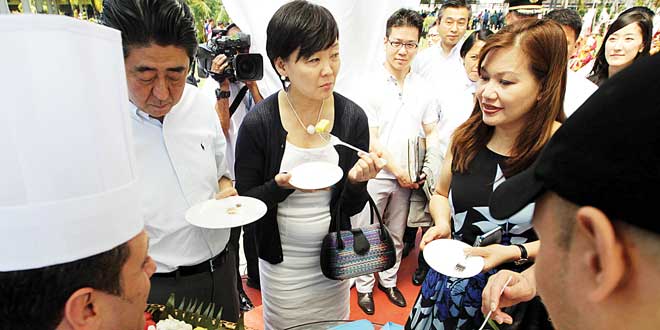
The visit of Japanese Prime Minister Shinzo Abe was all about strengthening friendship between the Philippines and Japan that was given deeper meaning during Abe’s itinerary in Davao City, hometown of President Duterte.
Breaking protocol, Mr. Duterte and Abe toured the city and shared the traditional Filipino food and delicacies, including the host’s favorite mongo bean soup.
It was also a rare occasion when Mr. Duterte woke up early to welcome his important guest.
At past 9 a.m., the Japanese premier arrived at Mr. Duterte’s simple house in Dona Luisa Subdivision clad in white polo shirt with short sleeves. Mr. Duterte wore his signature plaid polo shirt.
They had a photo souvenir in front of the President’s house and were greeted by neighbors.
Mr. Abe toured the house of the President who showed the Japanese leader his bedroom and his “famous” mosquito net, said Special Assistant to the President Christopher “Bong” Go.
At breakfast, the two shared “biko” (sticky sweet rice), “suman” and “kutsinta” (rice cakes), “puso ng saging” (heart of banana) salad, “buko “juice and Earl Grey iced tea for drink.
The Prime Minister even had a taste of the President’s favorite mongo bean soup or “mongos” to the Bisaya (Visayans).
Go said that the three of them went to the second floor of the President’s house where they exchanged gifts as souvenirs.
Abe said Mr. Duterte’s house was one of the places he wanted to visit in Davao City. He and First Lady Akie arrived in Davao City around 9:40 p.m. on Thursday.
From Mr. Duterte’s house, the two leaders motored to the Waterfront Hotel for the meet and greet event and the naming of the Philippine Eagle in honor of Abe’s visit.
At lunch time, the Japanese premier and Mrs. Abe were treated to Davao’s pride and considered the king of fruits – the durian. There was also the Davao pomelo.
Abe and his delegation capped their Davao visit and left the city at past noon Friday.
The visit of the Japanese prime minister marked a stronger Philippines – Japan partnership.
Japan has committed to support the creation of business opportunities in the Philippines worth approximately ¥1 trillion yen (P334 billion) over the next five years, including a Japanese development assistance and private investments for the Philippines.
This was announced on Thursday night by Japanese Press Secretary Yasuhisa Kawamura, who said that to realize this ¥1 trillion support to the Philippine economy, Japan would establish a joint committee on economic cooperation and infrastructure and would also send experts to the National Economic Development Authority (Neda).
Japan will also contribute to infrastructure development such as in transportation and electric generation by taking advantage of Japanese technology.
The Japanese government is also committed to help spur the development of Davao City and the conflict-affected areas through support in irrigation, road construction, power generation and education.
To strengthen the security of the country and its anti-terrorism efforts, Japan will provide security-related equipment, according to Kawamura.
Both leaders, last Friday, also met with Filipino and Japanese businessmen having discussions at the Waterfront Insular Hotel here in Davao City about investment opportunities in the Philippines.
Mr. Duterte and Abe had a photo opportunity with the Filipino and Japanese business groups that joined the Japanese prime minister in his two-day official visit in the Philippines.
In his speech, Trade Secretary Ramon Lopez encouraged Japanese companies to invest in the Philippines.
He cited various reasons why foreign investors should invest in the country, including robust economic growth primarily driven by manufacturing, trade, real state, renting and other business activities.
He also said the Filipino population is younger compared with the rest of the world with median age of 23.1 years.
The Philippines is in a demographic sweet spot by having a young, employed, and more prosperous consumer-based population for the coming years, Lopez said.
He added that the country has human-capital advantage over other destinations with its English-speaking, honest and creative workforce.
It is best to invest in the Philippines because its economy is powered by strategic investment flows, it has a comprehensive national industrial strategy and a clear 10 plus one economic agenda crafted by the Duterte administration, and has strategic location advantage over other countries, the DTI chief said.
After meeting the businessmen, Abe and the President proceeded to an event where a Philippine eagle was named as a symbol of the growing friendship and partnership of Philippines and Japan. The leaders’ spouses, Akie and Honeylet, also graced the event.
Abe adopted the eagle, which was named “Sakura” during Friday’s event at the Waterfront Hotel garden area.
Sakura is a female, juvenile Philippine eagle rescued by indigenous people in Talaingod in Davao Del Norte. The bird was found in a river bank with a gunshot wound in its left abdomen. It is being rehabilitated by the Philippine Eagle Foundation (PEF) in its facility in Davao.
PEF reported that there are only 400 pairs of Philippine eagle left in the wild, hoping that Sakura’s successful rehabilitation would help boost the Philippine eagle population in the country.
Prior to Prime Minister Abe’s departure from Davao City, he visited the Mindanao Kokusai Daigaku (MKD) in Lanang in this city, meeting students and teachers there.
Mindanao Kokusai Daigaku is a tertiary institution of the Philippine Nikkei Jin Kai in Davao City, the school said in its website. It was registered with the Securities and Exchange Commission (SEC) on April 18, 2001.
Among the courses being offered are BS International Studies and BS Social Services. In a brief period, MKD boasted having received accolades such as in the National Nihongo Speech Contest sponsored by the Japan Foundation in Manila.
MKD is established primarily to help the young Filipinos of the 21st century in the pursuit of academic excellence and service to humanity alongside their goal of becoming globally competitive.
Abe was the first head of state who visited the home city of Mr. Duterte under his administration.
Abe and his delegation left for Sydney around 12:30 p.m. Friday as he proceeds with his four-nation swing which will bring him to Australia, Indonesia, and Vietnam after visiting the Philippines.