 The Market Monitor Minding the Nation's Business
By Luis Leoncio
Japan firmed up its commitment to provide funding for the massive government spending pegged at about P1 trillion a year during a meeting between Philippine officials and their Japanese counterparts in Yokohama, Japan on the sidelines of the recent 50th Annual Meeting of the Asian Development Bank (ADB).
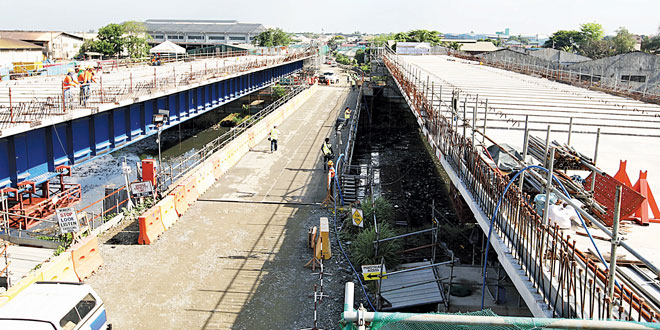
Japan Prime Minister Shinzo Abe in his visit to the Philippines last January pledged a 1-trillion yen financing package for the Duterte administration’s massive infrastructure buildup.
Finance Secretary Carlos Dominguez III had informed Japan Deputy Prime Minister and Finance Minister Taro Aso that topping the list of Manila’s proposed projects for possible Japanese assistance in terms of financing and technology transfer are the Mega Manila Subway and the Manila-Clark Railway Project.
Dominguez also expressed anew the government’s deep appreciation for Prime Minister Abe’s pledge of official development assistance (ODA) and loans to help the Duterte administration carry out its ambitious infrastructure program and effectively implement its campaign against illegal drugs.
In their Yokohama meeting, both Aso and Dominguez underscored the importance of infrastructure to the Philippine economy and how it could provide more jobs and facilitate trade.
Dominguez and Aso co-chaired the 20th Asean + 3 (China, Japan, South Korea) Meeting that was also held in Yokohama. Aso briefly discussed with Dominguez during the meeting Japan’s proposed bilateral currency sway arrangements with Asean, which Aso had proposed at the Asean + 3 Meeting.
Japan’s proposal was to set up a yen-based fund that will provide up to $40 billion to Asean economies under existing bilateral currency swap arrangements. The Philippines-Japan Joint Committee on Infrastructure Development and Economic Cooperation held its inaugural meeting in Tokyo last March to discuss the Philippines’ priority projects for possible implementation with Japan ODA financing and support.
Dominguez and other Philippine officials were in Yokohama last week to attend the 50th Annual Meeting of the ADB Board of Governors and other related meetings. The finance secretary assumed the chairmanship of the ADB Board of Governors ahead of this financial institution’s 51st Annual Meeting in 2018 that will be held in the Philippines.
The priority list covers projects in railway; irrigation; and public works projects covering road and flood management. Additional projects in the areas of public works, energy, and industrial zone development were also submitted by Philippine officials led by Dominguez as candidates for Japan ODA financing.
The first meeting of the Joint Committee followed the successful official visit of President Duterte to Japan last year and the reciprocal visit made by Prime Minister Shinzo Abe to the Philippines in January.
Mr. Duterte’s Cabinet officials have been presenting to the public the Duterte administration’s P8.4 trillion “Build, Build, Build” program through gatherings dubbed the “DuterteNomics Forum.” The big names in Philippine business, among them Jaime Zobel de Ayala of the Ayala Group, Tessie Sy-Coson of SM Investments Corp., Danel and Sandro Aboitiz of Aboitiz Equity Ventures, Edgar Injap Sia II of Double Dragon Properties Corp., Kevin Tan of Megaworld Corp., and Michael Tan of the LT Group Inc. have attended the forum in an apparent show of support for the government’s unprecedented spending plan on infrastructure.
“Dutertenomics” is President Duterte’s economic strategy to dramatically raise funds–in large part through his proposed Comprehensive Tax Reform Program (CTRP)–and spend big on infrastructure, human capital formation and social protection.
Dominguez said this bold strategy will enable the government to sustain the Philippines’ growth momentum, usher in the “golden age of infrastructure,” attract investments and create jobs, achieve economic inclusion and transform the Philippines into a high middle-income country by 2022, by which time poverty incidence will have been reduced to 14 percent (from 21.6 percent in 2015).
If “DuterteNomics” is sustained over the medium term, the government envisions the Philippines to be a high-income economy in one generation or by 2040.