 The Market Monitor Minding the Nation's Business

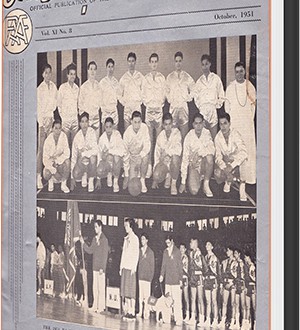
(Editor’s Note: Excerpted from the sports book “Years of Glory,” a history of Philippine basketball, and the National Five’s seven Olympic stints between 1936 and 1972, written by veteran sportswriters Noel Albano and Ignacio Dee. It will be released in June this year.)
Prologue
A helmsman named ‘Herr”
Just before the start of the 1952 Inter-collegiate basketball championship, UST coach Herminio Silva summoned his Goldies, the UAAP champions, for an unusual pep talk. “Fellows,” he began his exhortation, which Rafael Hechanova remembered with unusual clarity, “if we are going to win all our games…and San Beda wins all its games, we’re going to play San Beda with Caloy there. So this is what we will do. Right now, we start practicing to have a team defense against Caloy, because we have to neutralize him if we hope to win the title.”
By Caloy he meant Carlos Loyzaga, leader of the Red Lions and the NCAA’s most dominant player. Silva could seem a heroic figure but the fear of losing evidently compelled him to back track and take this extraordinary step of sharpening his defensive tactics. He was going to throw the whole Goldies’ armada at Loyzaga to disrupt his game. He would try to block, even overpower if there was a way, his sleek moves and firepower, which, unchecked, could singularly snap the Dominicans’ remarkable inter-collegiate title run.
The six-foot-three-inch, Silva had closely observed, attacked the basket most often through the baseline, propelled by his excellent footwork and ability to dribble well with either hand. His game plan was to deny Loyzaga the baseline and if he had the ball, force him not to dribble. “Once he started dribbling in to the basket, it was almost impossible to stop him,” Silva stressed. Then turning to Hechanova, he told him, “Paeng, don’t let him pass through, otherwise you’ll foul out. Just push him up so that the other guys could help and tap the ball from him, or force him to shoot from the baseline.”
If somebody else took the shot, only six-foot-one-inch Ramon Manulat, UST’s other tough guard who had the size and leaping ability, would go for the rebound. The rest of the Goldies would orchestrate the moves to box Loyzaga out of the rebound, and Hechanova had the singular, exhausting task of keeping at bay the country’s best player. “Paeng, don’t ever, ever jump for the rebound,” Silva emphatically told him. “Just keep Caloy out of that area. No follow-up!”
The Goldies began their defensive drill three weeks early. It was neither a zone nor a man to man, Hechanova recalled, “just the concept of a team defense. Every player was conscious that we had to neutralize Caloy if we have to win the game.”
Lions, Goldies on collision course
San Beda and UST swept past their opponents and expectedly tangled in the final round, but it came with a surprising twist. The man most Goldie fans feared would wreck their title hopes had been sidelined, so that the strongest team that posed the greatest threat to them was the La Salle Green Archers, whom they routinely crushed, 51-41. In the final against San Beda, the Red Lions’ game was abysmal without their sparkplug, and UST marched off to its national collegiate coronation in an anti-climactic way. “Coach Silva took no chances, of course,” the Filipino Athlete reported. “With the same calculating and stalling game that he employed in winning the UAAP pennant, he secured the National collegiate crown for the UST trophy cupboard without as much as giving the bewildered Bedans a chance to take the lead during the full forty minutes of play.”
Silva’s win was a “wonderful piece of strategy…the same speed of cage magic that he wove around the coliseum floor during the UAAP season.” Hardly had a winning coach been praised for his cage magic. Silva wasn’t moved to respond, nor did he grant press interviews. He was intensely private, an essentially impenetrable man who expressed eloquence only with the expert shuffling of his men and changes of pace and tactics on the floor.
It was an understatement to say Paeng admired Silva. He had come under the master as a malleable youth, almost like a plebe with great promise and potential, and the right attitude to go through pain as the price of learning. Silva didn’t overwhelm although by reputation he was stern with his players. What he was, was the prototypical old-school coach, who worked out meticulous preparations for every game, leaving little to chance. His defense was a master plan of distraction and disruption. He would force the player with the ball to give up his dribble or to move out of rhythm, never allowing him “to dictate where he wanted to go,” in the phrase of the sports columnist Joaquin Henson, citing a former national player who quoted Silva. He enjoyed enormous success owing to his keen ability to anticipate, yet another proof of his rigorous mental games.
And when his offense went to work, he scored victories that had the quality of being tactically sound though seemingly artless, fashioned under the old rules of the game. Ramon Campos Jr., Silva’s protégé in the late forties and UST’s first pure scoring machine, thought of his coach as always going for “a slower pace.” This was because the name of his game was control; it was the element he sought to impose through his command of the rules and their nuances. Hechanova remembered the time the rules had called for a jump ball in the last two minutes of the game. “He (Silva) got one of those gangling guys who was very tall,” he said. “Every last two minutes, Silva would insert him in the game. That’s all that he did.”
He was a man deeply passionate about winning, always out to fine-tune his tactics. Snatches of memory, like those of Hechanova and Campos, revealed a mentor who, in an era when television was unimaginably light years away from showing basketball films of college or pro teams, turned to reading up on basketball literature. And there were not too many experts who were engaged in writing, basketball being then still very much a game for a gym or a slightly larger arena.
A studious tactician
Yet undeterred, Silva soaked up on basketball knowledge. On nights Paeng had strolled across the UST campus on the way to the gym, he often caught him in his office “looking through basketball books, those soft-cover type, and I could see him studying.” His players spoke of him in a reverential tone, the descriptive words “strategist” and “tactician” always accompanied by the adjective “brilliant.”
His name, compressed into “Herr,” was evocative; it had the aura of an exacting disciplinarian, which he absolutely was, feared by his opponents—and feared and loved by his players.
During the forties and up to the mid-fifties, his word on the court was the law for the Goldies. Typifying this, he called for the team’s daily two-hour workout after the last class of the night so he could bring in the working students like Hechanova. Silva would blow his whistle promptly at 9 o’clock and “accepted no excuses from the latecomers.” He sent his players off to warm up by making them run twenty laps around the court.
In particular he took an early interest in Hechanova, then fresh from Iloilo City, a solidly built backcourt asset already getting serious notice for his promising defensive skills. And like an artist at work, he proceeded to chisel the player into the best defensive specialist of the fifties. The defensive mantra Hechanova had mastered was typically Silva-esque: “Protect the baseline always, never allow a dribbler to pass through.” At six-feet-one, he grew into a guard of surpassing ability to whom belonged the most difficult defensive task in any game, which was to shut down the enemy’s top scorer.
Remarkable as he was plugging the lane, Paeng’s multi-dimensional talent included being a gem of a defensive rebounder. “Why did I take all the rebounds like Dennis Rodman of the Chicago Bulls? Because Silva kept me in the gym. It was one of the best lessons I learned from him,” he said. It all started one night after an exhausting team workout. Though the hour was late, Silva ordered him not to leave “When everybody else had gone home, he told me, ‘No Paeng, you stay’. So I stayed, and he taught me everything.” Hechanova missed no single lesson on rebounding handed out like a gem by the self-sacrificing mentor. “He threw the ball into the ring several times and told me each time, ‘Paeng, follow the trajectory of the ball with your eyes; get use to that, the trajectory, and you will learn where the ball is going to land. You’ll always be one step ahead of everybody else.’”
Some other nights Silva varied his drill; one unfolded oddly enough. He had Hechanova stand on one spot in the court and several basketballs were randomly passed to him from different angles, some passes he could see coming, others just outside his visual range. To catch those coming from his blind side was difficult.
“After I passed back one ball, I saw another one coming and so on and so forth,” he said. “I had to keep on, getting my eyes to see them. This was what Herr did to me; he increased my peripheral vision.”