 The Market Monitor Minding the Nation's Business
Transportation Secretary Arthur Tugade presented to an international audience the Philippines’ airport development plan that aims to accelerate poverty reduction and transform the country to be among the largest economies in the world by 2022.
During one of the sessions that focus on Dutertenomics at the World Economic Forum (WEF) on Asean in Cambodia’s capital, Tugade said the total airport development of the Philippines consists of two phases — developing the existing and opening the possibility for new airports.
At present, there are two airports that serve as the main gateways into and outside the Philippines-the Ninoy Aquino International Airport in Manila and the Clark International Airport in Pampanga.
According to the Philippine Transportation chief, the plan is to develop the terminals at Clark airport, a former American military base, since it has two state-of-the-art runways.
“The target to develop the Clark terminal in two to two-and-a-half years. This will be complemented by a railway project which will connect Clark to Manila in just 30 minutes,” Tugade said.
At present, travel time from Manila to Clark and vice versa takes around two to two-and-a-half hours.
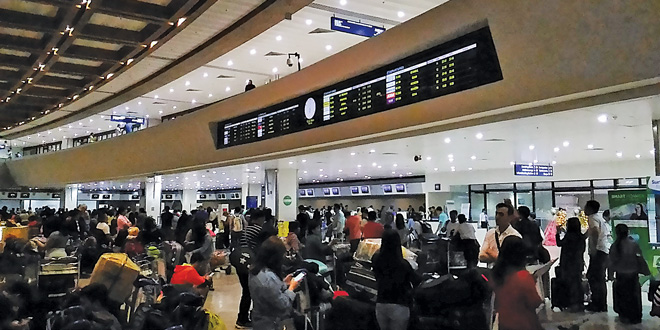
As for Naia, the Philippine official noted that the Philippines foremost airport would outlive its utilization because of the growth of the economy and the population as well as the improvements in technology.
“The direction for Naia is to develop what is there right now. Development will undertake various aspects: the development of the utilization of the place, improvement on the structure to expand its capability to handle more moving passengers and to include and use tech to enhance security and safety in consideration of various global threats,” Tugade said.
But while this is happening, Tugade said the government is not shutting the door of opening the possibility of other airports provided that these are within the purview of the requirements of international airport regulatory offices.
He said that the government is studying two proposals — one in Bulacan north of Manila and in Sangley Point, another former American base, in Cavite at the south.
“The proponent in Bulacan has proposed to build an airport with four runways. Meanwhile, the development of Sangley would be holistic, an airport and a possible seaport,” Tugade said.
But considering time constraints, he said the government would prioritize what could be easily done and what could easily be handled — improving the present.
“As we improve the present we look at the future and the possibilities and potentials of opening of other airports to handle expanded requirements of international standards is there,” Tugade said.
Meanwhile, the DOTr will no longer entertain unsolicited proposals from the private sector for the construction of a new passenger terminal at the Clark International Airport and will just bid out the operations and maintenance of the airport in the future.
Tugade mentioned in a recent interview that he prefers the government to be in charge of the development of the Clark Airport rather than risk delays in the event a bidding involving private sector players would lead to litigation that would eventually place the project on hold.
“If it’s bidding, what do you think will happen if a lot of investors want to participate? It will just prolong the development. That is why we will just do it ourselves. We could just bid out the operations and maintenance of the airport in the future,” Tugade told reporters on the sidelines of the groundbreaking ceremony of the LRT-1 Cavite extension project last week.
The Duterte administration is pushing for the hybrid mode of implementation where the government will develop infrastructure projects and bid out the operations and maintenance to the private sector. This will enable government to fast-track projects without the risk of delay brought about by possible lawsuits filed by losing bidders.
The DOTr will inform Megawide-GMR and JG Summit-Filinvest which submitted their respective unsolicited proposals on the Clark airport development of the new policy.
The government envisions the Clark International Airport to serve as an alternative gateway to the congested Ninoy Aquino International Airport in Metro Manila.
The Clark International Airport expansion project aims to construct a new passenger terminal building to accommodate 8 million passengers annually as well as the construction of all required facilities to support its operations.
It now falls under the jurisdiction and responsibility of the Bases Conversion and Development Authority (BCDA), and remains to be one of the priority infrastructure projects of the Duterte administration. The BCDA targets to open the new terminal by 2019.