 The Market Monitor Minding the Nation's Business
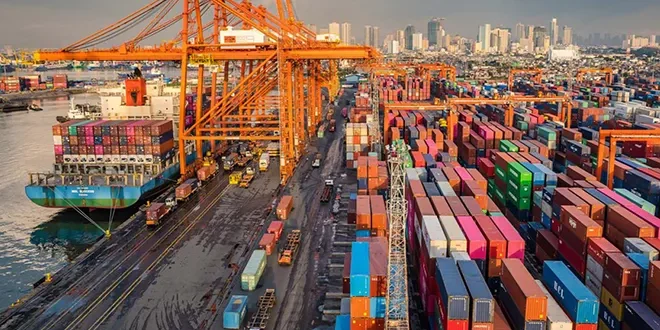
The country’s trade deficit widened in June from a year earlier on higher imports and exports, preliminary data from the Philippine Statistics Authority (PSA) showed on Thursday.
At $4.94 billion, the shortfall was 12.3 percent higher than the $4.4 billion posted a year earlier. It narrowed, however, from the $6.1 billion seen in May.
Total trade in goods reached $22.48 billion in June with imports accounting for $13.71 billion and exports $8.78 billion, up by 19.6 percent and 24.1 percent compared to a year ago.
Imports growth improved from the year-earlier 15.6 percent but exports were slower than the 26.9 percent posted in June 2025. On a monthly basis, imports slowed from May’s 28.2 percent while exports surged from 8.6 percent.
Year to date, the trade deficit rose to $30.81 billion, up 12.3 percent from the $24.48 billion recorded in the first half of 2025.
Electronic products remained the country’s top export at $5.25 billion, accounting for 59.9 percent of outbound merchandise shipments. This was followed by other mineral products ($414.85 million, 4.7 percent) and other manufactured goods ($401.37 million, 4.6 percent).
The United States was the biggest buyer of Philippine-made goods with a 20.1 percent share worth $1.76 billion. Rounding out the top five were Hong Kong ($1.34 billion, 15.3 percent), China ($1.0 billion, 11.4 percent), Japan ($990.16 million. 11.3 percent) and Singapore ($508.18 million, 5.8 percent).
Electronics were also the country’s top import at $4.77 billion or 34.8 percent of the June total. Mineral fuels, lubricants and related materials were next at $1.62 billion (11.8 percent), followed by transport equipment ($998.94 million, 7.3 percent).
China was the country’s top source of imports at $4.35 billion, or 31.7 percent of the total. Other major suppliers were South Korea ($1.78 billion, 13 percent), Japan ($919.13 million, 6.70 percent), Indonesia ($912.63 million, 6.66 percent),and the US ($706.70 million, 5.2 percent).