 The Market Monitor Minding the Nation's Business
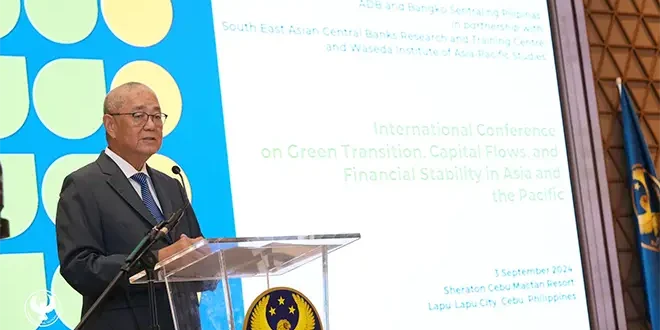
Bangko Sentral ng Pilipinas (BSP) Governor Eli M. Remolona, Jr. emphasized that central banks possess the regulatory tools to manage critical climate risks. He said this at the recent “International Conference on Green Transition, Capital Flows, and Financial Stability in Asia-Pacific” in Mactan.
According to the Governor, central banks that recognize climate risk as an “implied mandate” can draw from rules for managing systemic risks, such as designating systemically important banks or assigning appropriate capital levels for risks taken.
“These tools can be harnessed to push for greater climate adaptation,” said Governor Remolona, describing climate risk as the “ultimate systemic risk.”
To help the financial system manage climate risks, BSP Assistant Governor Lyn I. Javier shared that the BSP continues to engage supervised institutions to clarify expectations.
She also stressed the importance of capacity-building, noting, “This is where development partners, such as the Asian Development Bank (ADB), come in because they can bring in experts that could capacitate the industry.”
On the other hand, BSP Assistant Governor Pia Bernadette Roman Tayag underscored the need to unlock private capital to support sustainable projects, particularly for sectors most vulnerable to climate risks, such as small businesses.
“We need to encourage innovative financing mechanisms that allow projects to access international capital. This goes hand in hand with our efforts to develop our domestic capital market, to provide alternative sources of financing,” Assistant Governor Tayag pointed out.
The conference, organized by BSP in partnership with ADB, South East Asian Central Banks (SEACEN) Research and Training Centre, and Waseda Institute of Asia-Pacific Studies, tackled key topics, such as bolstering green investments for developing economies, pricing climate risks, and mobilizing private capital for low-carbon transition initiatives.