 The Market Monitor Minding the Nation's Business
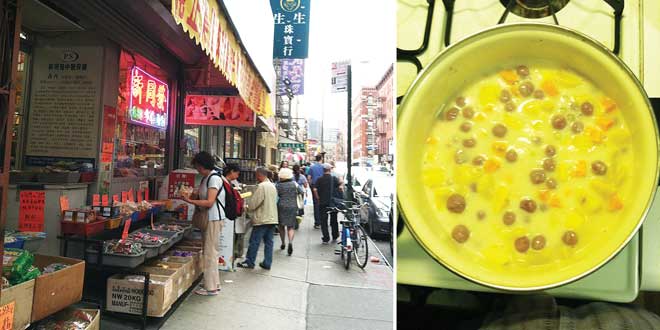
 No special occasion, really. A few spoonful at a time for dessert or as a second breakfast would be it, though I like it mixed with fruits, cereal and wheat bran, cold, for breakfast, concocting a new taste, which, while signaling the satiation of a longed-for flavor and an affirmation that the home we carry remains lodged within, also hints at the infusion of lived other-cultures.
But back in the apartment, still sniffing flavors of the pompano with tausi that we had for lunch in a tight market cum stool-and-ledge to eat in Mulberry St., finally with the ingredients for guinataan readied, we began to knead the galapong, rolled and set aside about two dozens of marble-smooth bilo-bilo. In separate bowls, cubed sweet yam (kamote), sliced plantain (saba), and langka as well as the tapioca pearls (sago) would lie in wait for the coconut milk to heave into a boil. Our guinataan would be done in 10 minutes.
If back in the Philippines, a mere tricycle ride to market would make such a bowl possible, nay a pot, in New York, it had to be a subway ride to Chinatown, and through a network of knotty streets, one braids into with clumps of doddering elderly, and carts of produce that often almost topple you over. But, for Filipinos, like a friend and I, what a heaven of robust salmon heads, as well as hill-sized mounds of pea tips (talbos-ng-camote-like) for salad, radish as round as my arm, perfect for sinigang na baboy and crisp bak choy (pechay) to top it with—yet, focused we must on the guinataan.
Our first stop would have to be Mulberry St. closest to where we got off the N train, on to a grocery for malagkit, a bag from Thailand for the right smoothness; next two streets north, on Hester and Elizabeth Sts., where, at Hong Kong Supermarket in a tunnel of shelves stacked with soy sauce of a dozen brands, including Datu Puti, and noodles as familiar as Nissin, we’d find the canned langka and coconut milk, and lastly, along an aisle for miscellaneous ingredients that include sago—all from Thailand quite like ours.
Before Chinatown, we had crossed yards with Koreans, whose produce markets sell the sweetest yam, yet, and Hispanics, for saba (plantain).
Going to Spanish Harlem in the Upper West Side, by the way, heightens the pining for home—how couldn’t one swoon with chicharon, called cuchifritos, gleaming through restaurant windows exactly like lechon kawali, and at a corner sidewalk umbrella-stand, sa malamig tended by a Mexican woman, who scoops the milky drink from a small transparent barrel into a plastic cup, easily a scene in Manila streets or along highways inward to Laguna.
If our “pilgrimage” to Chinatown for guinataan sounds a bit extreme, consider how some friends would drive from New York to Toronto for a bag of Laguna lanzones, and occasionally to New Jersey for Max’s chicken, with some Manhattan-ites leaping regularly across the East River to Jackson Heights in Queens for lunch either at Jollibee or House of Inasal.
Hence, among Filipinos, merely getting to Chinatown and other community markets that draw daily crowds like furious bees, and how one feels elated with but the sight of taho in plastic tubs, for one, or whiffs of say, what’s like pancit any which way, giving in to an impulse to have some, could heal—but more so, a bowl of ginataang bilo-bilo transported to an apartment in New York.
Consider sounds afloat with it—no crowing roosters, yelping dogs, squalling children, high-pitched mother’s calls for missing kids, and vroooming diesel-driven tricycles, screeching on dirt paths; flowing with the steady air, instead, could be a kind of distant roaring like the sea, an occasional scream of sirens on a 911 call, and the timed grating of steel to steel on subway tracks on a typical Manhattan Sunday morning.
While none such weekend sounds blends with the precious taste of guinataan, objects on a wall in the apartment, obviously choices guided by nostalgia, would conjure the apt mood—consider a tiny oil painting of a nipa hut idyll picked up from a side street on Session Road in Baguio, and a doll in pink Maria Clara gown tucked into a luggage some forgotten-return-trips years ago, now propped up beside the TV.
Exile, indeed, often descends in thick fumes of grey longings, so much so that a mere aroma from crevices of forcedly forgotten memories could dissipate it. Beyond bodily nourishment, as we know so well, food, that has inscribed a distinct taste, flavor, and texture in us, turns out to be a driving force in our lives, and migrations enhance it.
Still, culture, as label, does not quite cover the essence of this invisible force; even if pockets of other cultures spinning magic from food traditions do enrich the character of cities, indeed, only experience reveals that no matter the resentments or how glossed over the intermingling of races from centuries of colonization, legacies and genes cannot be tamped down, rising unbidden especially for food, like ginataang bilo-bilo.