 The Market Monitor Minding the Nation's Business
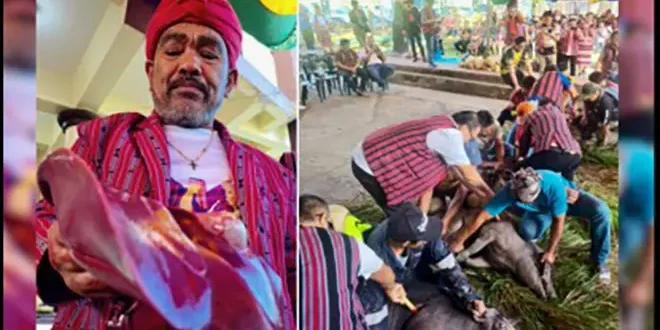
LA TRINIDAD, Benguet — A total five black pigs were offered to kabunyan (supreme deity) as this capital town celebrated Indigenous Peoples Month, with a “mambunong” (native priest) wearing leather boots becoming the focus of attention during the traditional rites.
Mambunong Peter Aguilba, 68, led the ceremony, chanting in the vernacular prayers for blessings and protection from the heavens and the ancestors for the town’s indigenous communities.
The Ibaloi and Kankanaey tribes dominate this Benguet town.
As the pigs were slaughtered, with sharpened wooden sticks called owik thrust directly into their hearts, Aguilba called on those who heard the squeals to join the day-long kanyaw(feast) and dance the tayao (traditional dance) to the rhythm of gongs.
“The louder the squeal, the better, so the gods can hear the people’s clamor for peace and progress,” he said.
Beneath the celebration, however, there is a concern.
Richard Wacnisen, the Indigenous Peoples Mandatory Representative (IPMR) to the Sangguniang Bayan (municipal council) of this capital town, said that the practice of having a mambunong must continue as indigenous cultural communities still perform rituals based on time-honored traditions.
“They are a vanishing breed and we are at a loss on how many are still there,” he said. “Our tribes must educate and train future native priests because our cultural practices are here to stay.”
Wacnisen, a kankanaey, feared that the decreasing number of traditional priests would leave unattended those clans and families who want their sick to be prayed over by the mambunong or to lead a thanksgiving ceremony following a bountiful harvest.
Even Aguilba, a farmer from Ambiong and considered the most sought-after mambunong, cannot estimate their number.
He said that no formal schooling is required for one to become a mambunong.
“As one grows old, he needs to know the customs and traditions of his tribe, get immersed in the beliefs and practices, and be present during rituals to better appreciate one’s craft,” he explained. “There are no ceremonies to bestow the honor.”
Valdred Olsim, municipal tourism officer, said his office will soon undertake research on the status of the town’s native priests and find out how many of them are still alive.
Mayor Roderick Awingan acknowledged it is timely to do an inventory of the town’s remaining traditional priests to document and support them.
“We have programs for senior citizens and centenarians. It is high time we give particular attention to our rare breed of native priests,” he said.
Awingan said he himself could not do away with the help of the mambunong.
Before he filed his candidacy for mayor in the May 2025 elections, he said he sought the blessings from the gods and got the services of a native priest.
“We butchered and offered a native chicken at that time,” he recalled.
Aguilba demonstrated what a mambunong could do. After the pigs were opened, he examined their livers and bile sacs, interpreting them to determine if any of them presented a bad omen.
“The livers were spread with less bile and blood. This means the occasion can proceed as it will bring progress to all,” he said.
He stated there’s no science at play, just wisdom from years of experience. He can’t remember how many rituals he has conducted or how many pigs he has slaughtered.
He noted that a mambunong must never accept money for prayers, calling it taboo that would destroy the sacredness of the tradition.
As for his leather boots, he smiled and said he simply feels comfortable wearing them.