 The Market Monitor Minding the Nation's Business
By Heidi Nicodemus
Following a ruling by the International Court of Justice (ICJ) in The Hague on the issue of the right to strike, the Maritime Industry Authority (MARINA) welcomed the landmark decision as embodying the fundamental component of freedom of association as this right is protected under international law.
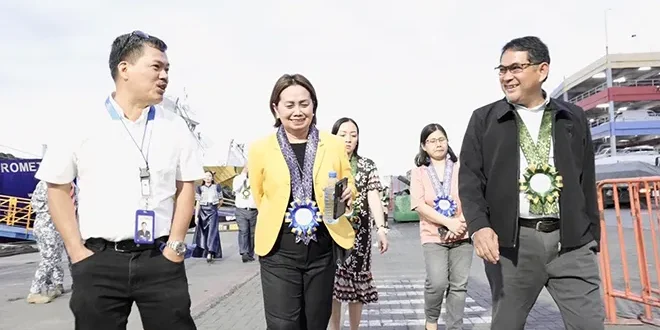
MARINA Administrator Sonia Malaluan expressed optimism in the proper implementation of the legal parameters governing the issue on the right to strike.
Malaluan enthused that the global maritime industry now faces developing challenges that keep attune to the changing environment so it is only justifiable that the right of seafarers are well protected and adaptive to the changing times.
“We look forward to the betterment of the industry because the maritime sector is critically significant in maintaining connectivity within the global community to ensure trade and economic development and prosperity,” she stressed.
Accordingly, the decision by the United Nations’ highest court settles a long-standing debate within the International Labor Organization (ILO) even as it explicitly confirms that worker strikes are shielded under ILO Convention 87.
For global seafarers and logistics personnel navigating increasingly volatile global trade lanes, the ruling codifies their ultimate legal safeguard during industrial disputes.
Global trade unions also hailed the ruling as a monumental victory that restores legal certainty to international labor standards.
“Transport workers keep the world moving and today, the International Court of Justice has confirmed our right to strike is protected under Convention 87 as fundamental to freedom of association,” International Transport Workers’ Federation ( ITF) General Secretary Stephen Cotton pointed out.
Cotton added that the ruling marks a critical moment to reinforce multilateralism and social dialogue for millions of transport workers worldwide who “have long fought to defend their jobs, their safety, their lives and their fundamental right to withdraw their labor.”
The legal battle over the interpretation of Convention 87—originally adopted in 1948—has caused years of friction within the ILO, particularly between labor groups and employer representatives who questioned whether the treaty inherently guaranteed the right to strike.
By issuing this opinion, the World Court reaffirms decades of international labor jurisprudence. Representatives from the International Trade Union Confederation (ITUC) noted that the clarity provided by the court is vital not just for labor groups, but for stable industrial relations worldwide.
“This is an important moment for legal certainty, for social justice and for the credibility of the international labour standards system,” ITUC General Secretary Luc Triangle said in a statement. “The Court has confirmed that international law supports the longstanding understanding shared not only by unions, but across large parts of the ILO system for decades.”
The ITUC and its affiliate unions are now calling on governments, employers and ILO constituents to move forward in a spirit of cooperation. The responsibility of implementing and monitoring the follow-up to this ruling will now return to the ILO’s supervisory system to guide nations in applying the convention uniformly across global supply chains.