 The Market Monitor Minding the Nation's Business

The Duterte administration has lined up three options to finance the massive P8 trillion to P9 trillion in financing needed for the most ambitious infrastructure program in recent Philippine history, dubbed “Build, Build, Build”.
Budget Secretary Benjamin Diokno said the program will usher in a golden age of infrastructure in the Philippines.
Economic managers decided to pursue an expansionary fiscal policy, increasing the planned deficit from two to three percent of gross domestic product (GDP) for the next six years, he said.
Diokno alo said the government will borrow money to finance the deficit, following an 80-20 borrowing mix in favor of domestic sources.
“Such a financing mix will mitigate against foreign exchange risks,” he added.
He expects the economy to outgrow its debt burden as GDP growth is expected to outpace the increase in the rate of borrowing.
“Hence, the fiscal strategy is manageable and sustainable. In fact, the debt-to GDP ratio is projected to decline from 42 percent in 2016 to 36 percent in 2022,” Diokno said.
The borrowings will be complemented by higher revenue effort resulting from tax policy and tax administration reforms courtesy of the Comprehensive Tax Reform Package (CTRP) being proposed by the Department of Finance (DOF), he said.
It is expected to bolster revenue collection from 15.3 percent of GDP in 2017 up to 17.7 percent of GDP in 2022, with tax reform contributing more than P200 billion in revenues annually, he added.
The infrastructure program of the government will support rapid and inclusive expansion of the Philippine economy, having posted a robust growth rate of 6.9 percent in 2016, according to Diokno.
He added that adequate infrastructure must be put in place to support economic activity.
“It not only encourages mobility among people, but also a freer interaction among sectors. Good infrastructure is a necessary condition in sustaining our growth trajectory,” said Diokno.
The poor state of public infrastructure has hampered the competitiveness of the Philippine economy. According to the World Economic Forum Competitiveness Rankings, the Philippines has the worst overall infrastructure among the Association of Southeast Asian Nations (Asean)-5 members since 2010, Diokno said.
He added that the upgrading infrastructure will attract more investments and improve the competitiveness of the Philippine economy.
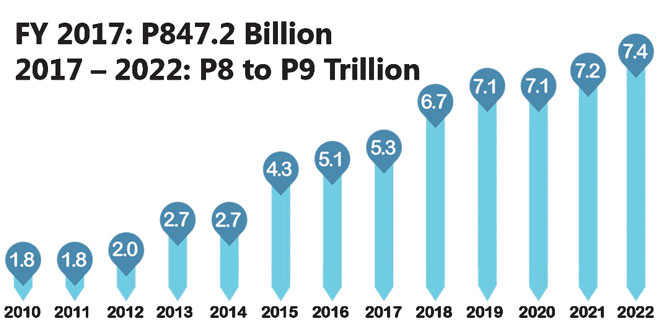
For this year, P847.2 billion in the national budget was allocated for infrastructure development, or equivalent to 5.3 percent of GDP.
“This is significant, because the Philippines has never reached the 5 percent of GDP threshold for infrastructure spending in the last 30 years. In fact, it only averaged 2.9 percent of GDP during the last administration,” Diokno said.
As a share of GDP, infrastructure spending will rise from 5.3 percent of GDP in 2017 to as high as 7.4 percent of GDP in 2022 that does not include private sector investments in power, water, and telecommunications.
The Department of Finance (DOF), in turn, said it is looking at three sources of initial funds for the flagship infrastructure projects which are the national budget, official development aid (ODA) and hybrid public-private partnerships (PPPs).
“We must use a combination of schemes,” Finance Undersecretary Karl Kendrick Chua said at a forum in Metro Manila.
Chua noted the amount of ODAs and PPP investments for infrastructure will vary.
For 2017 alone, however, he said the government targets spending P800 billion from the national budget to jumpstart infrastructure-building activities in the country.
Approval of DOF’s proposed Comprehensive Tax Reform Program (CTRP) will enable government to raise such amount by some P200 billion annually, he said.
The proposed CTRP consists of income, corporate, property, capital and environmental taxation packages, Chua said.
He also said the government targets to initially collect, through CTRP, about P366 billion in revenues.
“That’s the end goal in maybe two years,” he said.
He noted that CTRP’s income taxation package alone can net revenues totaling around P157 billion during its first year of implementation.
Chua said the DOF is open to studying other revenue-generating schemes to help bring forth infrastructure’s golden age in the country.
Tapping government-owned and -controlled corporations for such purpose is something DOF can explore, he added.
Earlier, Chua said the proposed CTRP will enable government to either build or improve 44,000 kilometers of national and local roads, construct more local hospitals and improve existing ones while enhancing public services.
DOF also said targeted for CTRP funding are the Bonifacio Global City-Ortigas Center Link Road Project; UP-Miriam-Ateneo Viaduct on C-5/ Katipunan Avenue; Metro Manila Priority Bridges Seismic Improvement Project (Guadalupe and Lambingan bridges); and widening/ improvement of the Gen. Luis Street-Kaybiga-Polo-Novaliches Road.
“Other projects to be funded by the CTRP are the Arterial (Plaridel) Road Bypass Project Phase III; Central Luzon Link Expressway, Phase II, in San Jose, Nueva Ecija; Pasig-Marikina River Channel Improvement Project, Phase IV; Marikina Dam flood-protection works in the Marikina River, including the Retarding Basin; Flood Mitigation Project in the East Manggahan and the Floodway Area (Stage 1); and several major flood-control projects,” the DOF said in April.
Accelerating strategic infrastructure development; attaining just and lasting peace; and ensuring security, public order and safety, as well as ensuring ecological integrity and a clean and healthy environment, are the four cross-cutting bedrock strategies supporting the three pillars of government’s 2017- 2022 Philippine Development Plan (PDP), noted National Economic and Development Authority (Neda).
Citing Neda, the DOF earlier said infrastructure spending must increase from 5.4 percent of GDP in 2017 to 7 percent in the succeeding years to achieve the country’s vision of reducing poverty and becoming an upper middle income economy by 2022 while being close to becoming a high-income nation by 2040.
Previous Philippine spending on infrastructure averaged just 2.7 percent of GDP. However, the Philippines’ Southeast Asian neighbors devoted at least 5 percent of their respective GDPs to infrastructure investments.