 The Market Monitor Minding the Nation's Business
By Tracy Cabrera
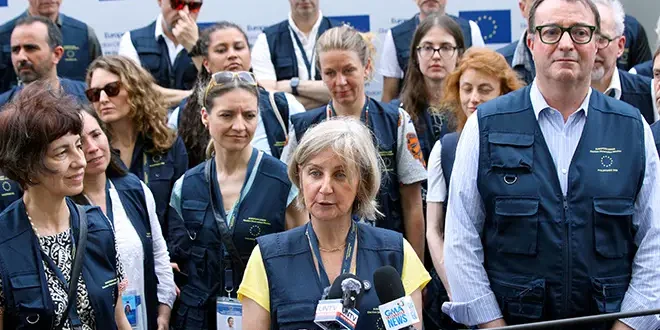
Vote buying remains a deeply rooted problem in Philippine elections, according to a foreign observation team mostly composed of representatives from European Union (EU) member countries.
In a preliminary report, the EU Election Observation Mission (EU-EOM) criticized the Commission on Elections (Comelec) for failing to effectively curb the illegal practice during the recent midterm polls, calling it “endemic and well-entrenched.”
The EU deployed the mission in March to monitor the entire electoral process. From the start of the campaign period to election day on May 12, the observers documented rampant vote-buying across the country. Despite Comelec’s supposedly stricter rules, candidates openly engaged in cash and in-kind vote transactions during campaign activities.
EU-EOM Chief Observer Marta Temido reported that “(their) observers witnessed several credible indications and received reports of vote-buying through cash and goods, as well as partisan distribution of welfare payouts (ayuda).”
The mission documented direct instances of vote-buying at five of the 98 campaign rallies it monitored, spanning provinces such as Bohol, Davao Oriental, La Union, Palawan, Quezon, Siquijor, and Zamboanga del Sur. In certain areas, the report highlighted “bidding wars” among candidates vying for votes.
It also flagged the partisan distribution of government aid, including ayuda and sacks of rice with President Ferdinand Marcos Jr.’s initials, along with the provision of free public transportation in Manila during Labor Day weekend—moves perceived to benefit administration-aligned candidates.
Beyond vote-buying, the EU observers expressed grave concern over what they described as “unacceptable levels of election-related violence.” The mission cited reports that at least 30 people, including candidates and election officials, were killed during the campaign period. On election day, at least 10 more fatalities were recorded, with violence concentrated in the Bangsamoro Autonomous Region in Muslim Mindanao (BARMM).
“While violence was more prevalent in local rather than national elections, it often aimed to intimidate stakeholders, thus influencing the overall atmosphere,” the EU-EOM noted.
The team also lamented restrictions placed on their access to polling stations. Despite prior commitments from Comelec, EU observers were barred from entering some precincts on election day. This led to a scaled-down deployment of 226 observers, limiting the team’s ability to witness the voting process firsthand.
“The EU EOM deployed its teams of observers across polling precincts in the country to observe counting. In eight of the 92 visited precincts, the EU observers were denied entrance, despite written assurances to the contrary provided by the COMELEC,” the mission stated.
Nonetheless, the team was able to monitor the vote-counting process in 84 precincts. Of those, 82 observations were rated positively.