 The Market Monitor Minding the Nation's Business
 While fasting and abstinence meant only one meatless meal, friends and I dreaded Lenten Fridays. At times, we practiced the extreme with just bread and water, though possibly only out of obedience—what do 14-year olds really understand in terms of self-denial for the atonement of sins, anyway?
I imagine I had pan de sal dipped in sugared evaporated milk or boiled egg sandwich of pan de sal also, for breakfast and “kinamatisan a pallileng” (now extinct in the Bacarra River) with rice as the day’s full meal.
In truth though, my memory backtracks only as far as my university years at the Immaculate Conception Ladies’ Hall on España that the RVM nuns managed, when, on Fridays (come to think, of it not only during Lent), we had Spanish sardines for breakfast and fried fish with tomato slices for supper, but either one as the only meal on Good Friday, with Skyflakes nibbled and washed with water (no Coke) in between.
It didn’t seem to make a difference then, what we did were the one-day closed retreats—could it be the rule of silence, nourishment from spiritual readings and prayers, examination of conscience and confession along with fasting? But still a mere girl then, I hardly recall moments of illumination, often conscious of a slight weakness from (self-suggested) hunger through the day.
But one Lenten weekend, I felt my body grow wings also from a fast with Zenaida Seva at her house; we subsisted on galletas, sardines, flavored tea, and readings, which did not include either the psalms or St. John of the Cross’ “The Dark Night of the Soul”—instead, passages from the I Ching or John Updike’s Rabbit Redux, then a bestseller. I had crossed boundaries in “search of my own self” by then, and fasted not in the spirit of penance, but more in the Buddhist path of tempering the senses.
Discovering wider vistas in Ongpin, abstinence came easier and more flavorful for us, with seafood dumplings, tokwa, and the best-ever kuchai ah from Poland Hopia. We couldn’t have enough of tochong bangus, as well as fish-head soup, at an upstairs steam-fogged eatery on Florentino Torres Street, said to have been frequented by then Manila Times reporters and notarios publicos, who might still be working on movable desks in half-lit pre-war rooms along Avenida.
Penance for me, later metamorphosed into existential anguish, fueled by my links with Jean Paul Sartre’s self-proclaimed followers during my graduate course in philosophy, which had alarmed a pious aunt. By this time, fish and chips served in waxed paper-lined baskets appeared somewhere on Avenida, and became synonymous with my Fridays. This indulgence had concerned my aunt that I had further lost my Catholicism by flinging the sacredness of penance and sacrifice for the savor of alien food: A fast should be a kind of sacrifice and prayer, and not the enjoyment of a meatless meal, she said.
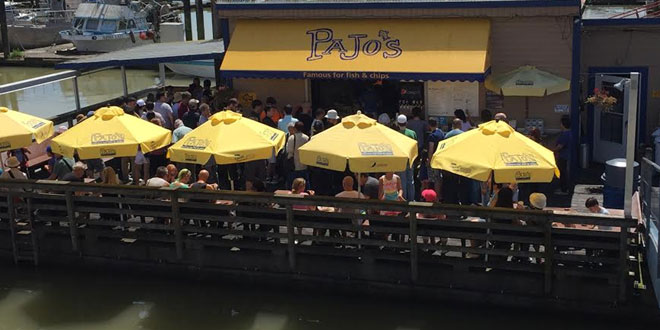
Could the lure of fish and chips that we noted from movies set in London, a foretaste of even more guilty pleasures? Even as I carried with me to Canada my aunt’s admonition, I felt nary a pinch of conscience with my first taste of fish and chips in British Columbia, where as a tradition, these are still served in shoreline restaurants like those in Steveston, White Rock or Horseshoe Bay.
A bottle of malt vinegar for sprinkling or dousing the British and Irish way, would come with chunks of breaded or battered fish—if orange-y, beer might have been mixed-into the batter—of late, cooked in vegetable oil switched from 19th century kitchen use of dripping or lard for taste.
But perhaps had she lived this long, it would have pleased my aunt to know that the swift passing of years had caught up with me since—indeed, its ironies as well. Real threats to health from eating meat have sealed my choices for protein sources so much so that even as the Church had relaxed days of fast observed on Lenten week only, a friend and I have taken it further by restoring the no-meat Fridays outside of Lent. Yet, the sense of adventure to stave boredom in taste still tickles us as we scoop the scents and flavors of more meatless food in bean burritos, vegetable samosas, eggplant parmigiana and falafel.
Rigid lines had since been loosened, as we know, like among many hooked on diets to attain rail-thin figures, fasting and abstinence have nothing to do with penance and sacrifice, also, as dietary prescriptions among those diagnosed ill from complications of overweight, as well, vegetarians, declaring a far better sense of well-being from no meat ever for meals.
I had finally grasped what in my youth seemed an incidental truth: That in shedding what drags us down through the senses, we find the path to spirituality and begin to unlock once elusive meanings. One thing glossed over in this piece: What one denies of one’s self, we should give to others, meaning, acts of charity should pair with no-meat and one full-meal days, which, anyway, most practice the whole year.