 The Market Monitor Minding the Nation's Business
by Annalyn S. Jusay
With the blueprint for a new UN Tax Convention approved last month, civil society organizations across Asia are intensifying their call to “Tax The Rich, Not The Poor” as they prepare to collect at least 1 million signatures this October in support of a campaign called the “Peoples’ Petition for Wealth Tax for Public Services & Climate Action.”
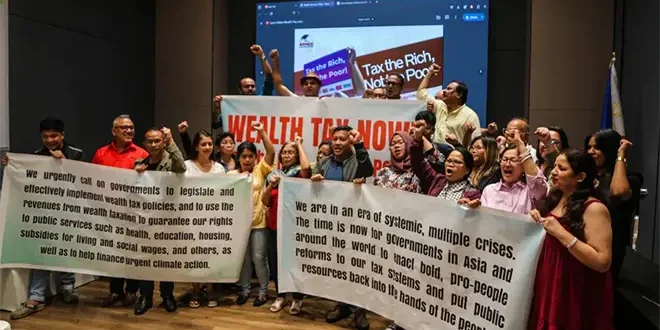
Leaders belonging to member-organizations of the Asian People’s Movement on Debt and Development (APMDD) gathered in a writeshop and strategy session last September 2 and 3 at Ardenhills Suites in Quezon City to amplify their call to “make the wealthy pay their fair share of taxes” amid a regressive system of taxation in the region which “burdens the urban poor, ordinary workers, women and other marginalized sectors of society.”
“We are urgently calling on governments to effectively implement wealth tax policies, and to use the revenues from wealth taxation to guarantee our rights to public services such as health, education, housing, subsidies for living and social wages, as well as to help finance urgent climate action in the petition,” APMDD coordinator Lidy Nacpil stated.
“Governments have for far too long allowed tax abuses and evasion of the super-rich and multinational corporations,” she added. “It is time to change deeply flawed tax systems that do not prevent illicit financial flows and are reliant on regressive taxes. Most governments now get the biggest share of their revenues from VAT or GST (general sales tax). This has resulted in common people shouldering heavy taxes while getting very little public services in return.”
Last August 16, of the Terms of Reference (ToR) for the development of a UN Framework Convention on International Tax Cooperation was adopted. Based on the ToR, governments will proceed to negotiate the new UN Tax Convention.
Luke Espiritu, lawyer and president of the Bukluran ng Manggagawang Pilipino, pointed out: “Workers in the Philippines earn starvation wages. Regressive taxes further erode their income. (But) taxation in the Philippines unfairly relies upon the working people through its reliance upon VAT. In contrast, corporate income tax has been reduced by the government from 30 to 25 percent. Indirect taxes compensate for this loss in revenue which affects basic services and the worker’s cost of living.”
Rovik Obanil, general secretary of the Freedom from Debt Coalition (FDC), noted that the bills for a wealth tax in the House of Representatives and FDC’s model bill are getting little support from Congress. He called on legislators to support progressive tax reforms and overturn TRAIN and CREATE that continue to favor tax cuts for corporations and maintain the dependence on regressive taxation.
Civil society leaders from Nepal, Malaysia, India and Pakistan were also present to articulate their position on the matter.
“The time has come for the ultra-wealthy to step up and contribute to the greater good of society,” asserted Aishwarya Visvanathan, a researcher for the Monitoring Sustainability of Globalisation (MSN) in Malaysia. “They have reaped billions in tax incentives for too long while the burden has fallen on the rest of us. It’s time for a fairer system that ensures everyone pays their share in advancing the Sustainable Development Goals and eradicating poverty.”
“In Malaysia, taxing the super-rich is not just an option—it’s essential for funding the social protection and welfare programs our society desperately needs. The fact that the top 50 wealthiest individuals in our country hold a combined wealth of RM390 billion—equivalent to our entire annual budget—speaks volumes. Even tapping into a small portion of this wealth could generate billions in revenue. This isn’t about punishing success; it’s about fairness.”
Farooq Tariq, the general secretary of the Pakistan Kissan Rabita Committee, lamented that the wealth tax imposed in Pakistan was not being paid by the rich. “They have used courts to get stay orders. Government is not taking any interest in the implementation of the wealth tax, while very eager to collect the GST imposed on almost all daily life goods. The poor in Pakistan are paying the luxuries of the rich in the shape of GST.”
Mecanzy Dabre of the National Hawkers Federation in India said “The gap between the rich and the poor has widened. In a country like India, 40 percent of the people struggle for a day’s worth of food, while the rich 1% of Indians own 90% of the country’s wealth. Wealth tax is necessary to bridge this disparity gap.”
“Tax systems need to be overhauled,” stressed Dr. Arjun Kumar Karki, the executive president of Rural Reconstruction Nepal. “We will petition for wealth taxes to be on the national agenda of our governments and in the UN Tax Convention being negotiated.
Jeannie Manipon, program manager of the APMDD Development Finance Program, said CSOs believe that the “The recent adoption of the Terms of Reference is a milestone in the fight to end inequalities in global tax rules and to make them work for people and the planet We expect governments in Asia to adopt a UN Tax Convention during the 79th session of the UN General Assembly this September, and it should be anchored on upholding parity and sovereignty of nations; advancing human right and sustainable development, ensuring equitable allocation of taxing rights and harnessing taxation’s redistribution function.”
The CSOs also have a theme song – “Tax the Rich, Not the Poor” – which they hope to popularize as part of the campaign.